Showing posts with label activism. Show all posts
Showing posts with label activism. Show all posts
Monday, February 21, 2011
RSA Animate: Smile or Die
Interesting, provocative, and slightly contratrian talk by Barbara Ehrenreich


Friday, July 9, 2010
Oakland Needs to Come Together
At about 10:30 PM last night, forty or fifty high-school age kids descended upon the Whole Foods store across the street from my apartment. Most of the kids stood by and watched as three or four used a trash can, a store sign, and rocks to smash the windows of the store front. Three security guards quickly came out of a side entrance with guns raised at the crowd. They yelled loudly and repeatedly to back up. The group moved away but did not leave the scene. One or two resumed breaking windows on the other side of the store. It was a tense five to ten minutes before a police van arrived, causing the crowd to immediately disperse.
The scene reminded me of my mischievous days in high school, when the freshman soccer team went out and toilet papered a neighbor's house before a big game. I thought the same sort of thing happened last night, with the kids using the verdict of the Mehserle trial as a similar excuse to stir up trouble. We both picked out a clear target, leaving the other stores, residences, and cars relatively unscathed. But when someone with authority showed up, we scattered. Who knows what we would have done if the neighbors hadn't woken up and unleashed their dog on the soccer team, or if the police hadn't shown up at Whole Foods last night?
It is sad to witness the destruction of property, but it's even more sad to see people bury their heads in the sand. When the news media announced that the verdict was to be read yesterday at 4 PM, the responsible workers of our city left Oakland in droves. Since then, much of the city has been shut down, due to a collective fear being spread from the top down. But, the best thing for this community is to come together and to face our troubles collectively. How can we run away from the kids that we are supposed to care for and teach?
The scene reminded me of my mischievous days in high school, when the freshman soccer team went out and toilet papered a neighbor's house before a big game. I thought the same sort of thing happened last night, with the kids using the verdict of the Mehserle trial as a similar excuse to stir up trouble. We both picked out a clear target, leaving the other stores, residences, and cars relatively unscathed. But when someone with authority showed up, we scattered. Who knows what we would have done if the neighbors hadn't woken up and unleashed their dog on the soccer team, or if the police hadn't shown up at Whole Foods last night?
It is sad to witness the destruction of property, but it's even more sad to see people bury their heads in the sand. When the news media announced that the verdict was to be read yesterday at 4 PM, the responsible workers of our city left Oakland in droves. Since then, much of the city has been shut down, due to a collective fear being spread from the top down. But, the best thing for this community is to come together and to face our troubles collectively. How can we run away from the kids that we are supposed to care for and teach?
Tuesday, June 8, 2010
Monday, May 11, 2009
Sunday, April 26, 2009
Suggestions for Becoming a Positive Deviant
1. Ask an unscripted question.
e.g., "Where did you grow up?" or "Did you watch the game last night?"
It's not that making this connection necessarily helps anyone. But you start to remember the people you see, instead of letting them all blur together. If you ask a question, the machine begins to feel less like a machine.
2. Don't complain.
Resist it. It's boring, it doesn't solve anything, and it will get you down. Just be prepared with something else to discuss: an idea you read about, an interesting problem you came across. See if you can keep the conversation going.
3. Count something.
One should be a scientist in this world. In the simplest terms, this means one should count something. If you count something interesting, you will learn something interesting.
4. Write something.
Writing lets you step back and think through a problem. By offering your reflections to an audience, even a small one, you make yourself part of a larger world. The published word is a declaration of membership in that community and also of a willingness to contribute something meaningful to it.
5. Change.
Be willing to recognize the inadequacies in what you do and to seek out solutions.
from Better by Atul Gawande
e.g., "Where did you grow up?" or "Did you watch the game last night?"
It's not that making this connection necessarily helps anyone. But you start to remember the people you see, instead of letting them all blur together. If you ask a question, the machine begins to feel less like a machine.
2. Don't complain.
Resist it. It's boring, it doesn't solve anything, and it will get you down. Just be prepared with something else to discuss: an idea you read about, an interesting problem you came across. See if you can keep the conversation going.
3. Count something.
One should be a scientist in this world. In the simplest terms, this means one should count something. If you count something interesting, you will learn something interesting.
4. Write something.
Writing lets you step back and think through a problem. By offering your reflections to an audience, even a small one, you make yourself part of a larger world. The published word is a declaration of membership in that community and also of a willingness to contribute something meaningful to it.
5. Change.
Be willing to recognize the inadequacies in what you do and to seek out solutions.
from Better by Atul Gawande
Wednesday, February 11, 2009
The Destructive Cult of Celebrity
We all have gods, it is just a question of which ones. And in American society, our gods are often celebrities.
In celebrity culture, the object is to get as close to the celebrity as possible. Those who can touch or own a relic of the celebrity hope for a transference of celebrity power.
Real life, our own life, is viewed next to the lives of celebrities as inadequate and inauthentic. Celebrities are portrayed as idealized forms of ourselves. It is we who are never fully actualized in a celebrity culture.
Soldiers and Marines speak of entering combat as if they are entering a movie, although if they try to engage in movie-style heroics they often are killed. The difference between the celebrity-inspired heroics and the reality of war, which takes less than a minute in a firefight to grasp, is jolting. Wounded Marines booed and hissed John Wayne when he visited them in a hospital in World War II. They had uncovered the manipulation and self-delusion of celebrity culture. They understood that mass culture is a form of social control, a way to influence behavior that is self-destructive.
Celebrity culture is a hostile takeover of religion by celebrity culture. Commodities and celebrity culture alone define what it means to belong to American society, how we recognize our place in society and how we determine our spiritual life.
Our choice of brands becomes our pathetic expression of individuality. Advertisers use celebrities to promise us that through the purchase of a product we can attain celebrity power.
Celebrity culture plunges us into a moral void. The highest achievements in a celebrity culture are wealth, sexual conquest and fame. These values are hollow hallucinations that leave us chasing vapors. They urge us toward a life of self-absorption. They tell us that existence is to be centered on the practices and desires of the self rather than the common good.
Celebrity culture encourages us to turn our love inward, to think of ourselves as potential celebrities who possess unique if unacknowledged gifts. It is the culture of narcissism. The banal chatter of anyone, no matter how insipid, has in celebrity culture cosmic significance. Reality, however, exposes something very different. And the juxtaposition of the impossible illusions inspired by celebrity culture and our insignificant individual achievements leads to frustration, anger, insecurity and a fear of invalidation. It leads to an accelerated flight toward the celebrity culture, what Chris Rojek in his book “Celebrity” calls “the cult of distraction that valorizes the superficial, the gaudy, the domination of commodity culture.”
This cult of distraction masks the real disintegration of culture. It conceals the meaninglessness and emptiness of our own lives. It deflects the moral questions arising from mounting social injustice, growing inequalities, and costly imperial wars as well as economic and political corruption.
The fantasy of celebrity culture is not designed simply to entertain. It is designed to keep us from fighting back.
Paraphrased from the column Truthdig column "What Price Hollywood" by Chris Hedges.
In celebrity culture, the object is to get as close to the celebrity as possible. Those who can touch or own a relic of the celebrity hope for a transference of celebrity power.
Real life, our own life, is viewed next to the lives of celebrities as inadequate and inauthentic. Celebrities are portrayed as idealized forms of ourselves. It is we who are never fully actualized in a celebrity culture.
Soldiers and Marines speak of entering combat as if they are entering a movie, although if they try to engage in movie-style heroics they often are killed. The difference between the celebrity-inspired heroics and the reality of war, which takes less than a minute in a firefight to grasp, is jolting. Wounded Marines booed and hissed John Wayne when he visited them in a hospital in World War II. They had uncovered the manipulation and self-delusion of celebrity culture. They understood that mass culture is a form of social control, a way to influence behavior that is self-destructive.
Celebrity culture is a hostile takeover of religion by celebrity culture. Commodities and celebrity culture alone define what it means to belong to American society, how we recognize our place in society and how we determine our spiritual life.
Our choice of brands becomes our pathetic expression of individuality. Advertisers use celebrities to promise us that through the purchase of a product we can attain celebrity power.
Celebrity culture plunges us into a moral void. The highest achievements in a celebrity culture are wealth, sexual conquest and fame. These values are hollow hallucinations that leave us chasing vapors. They urge us toward a life of self-absorption. They tell us that existence is to be centered on the practices and desires of the self rather than the common good.
Celebrity culture encourages us to turn our love inward, to think of ourselves as potential celebrities who possess unique if unacknowledged gifts. It is the culture of narcissism. The banal chatter of anyone, no matter how insipid, has in celebrity culture cosmic significance. Reality, however, exposes something very different. And the juxtaposition of the impossible illusions inspired by celebrity culture and our insignificant individual achievements leads to frustration, anger, insecurity and a fear of invalidation. It leads to an accelerated flight toward the celebrity culture, what Chris Rojek in his book “Celebrity” calls “the cult of distraction that valorizes the superficial, the gaudy, the domination of commodity culture.”
This cult of distraction masks the real disintegration of culture. It conceals the meaninglessness and emptiness of our own lives. It deflects the moral questions arising from mounting social injustice, growing inequalities, and costly imperial wars as well as economic and political corruption.
The fantasy of celebrity culture is not designed simply to entertain. It is designed to keep us from fighting back.
Paraphrased from the column Truthdig column "What Price Hollywood" by Chris Hedges.
Saturday, February 7, 2009
Live at the NYPL -- Slavoj Zizek and Henri-Bernard Levy
Watch a recent discussion between Slavoj Zizek and Henri-Bernard Levy on iTunes.
Friday, January 30, 2009
MIA speaks about music as agent for social change
Grammy- and Oscar-nominated artist MIA speaks about the Sri Lankan genocide of Tamils on the Tavis Smiley Show (Click link to view interview).
"The pressure of standing up for nothing is just so big."
"The pressure of standing up for nothing is just so big."
Tuesday, January 13, 2009
Wednesday, March 14, 2007
Asthma in the South Bronx
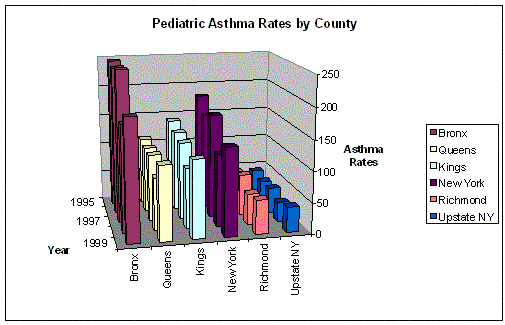
Recently, I learned that Harlem & the South Bronx have one of the highest rates of asthma in the nation. The illness particularly affects kids: in the U.S., asthma is the number one cause of school absences each year.
Why do so many kids in our area have asthma? Experts aren't sure, but many attribute it to pollution.
Here's an excerpt taken from an article written by Natalie Olivero in the Gotham Gazette:
Communities like East Harlem are burdened with polluting facilities, like a multi-storied diesel bus depot operated by the New York City Transit Authority, a sanitation truck depot, and a sewage treatment plant on Ward’s Island,” said Yolande Cadore, organizing director of the environmental justice group West Harlem Environmental Action, Inc. ( WE ACT), in an email. “These communities bear the burden of high asthmas rates, lung and heart disease, obesity and diabetes.
Why does pollution end up in the South Bronx? According to Yolande Cadore, it's because there's not enough people fighting to keep pollution of their neighborhood.
WE ACT takes a broader approach to alleviating asthma: They fight to keep pollution out of poor neighborhoods. Cadore says that city planners often build sewage treatment plants and bus depots in poor neighborhoods of color because they assume the community will not protest as much as a rich, white community might. Cadore said this is because historically minority communities have been less politically active, less likely to vote, and have had less money to sue.
One of our mottos at MH3 is to help students become community leaders. Perhaps this is what that motto means...To inform you of the issues affecting your community, and perhaps spur some into action. Folks, what can you do to make a difference?
Image take from S. Bronx Environmental Health and Policy Study
Subscribe to:
Posts (Atom)