"You know the solar system's a shooting gallery. And Earth, many people don't know, plows through several hundred tons of meteors a day. So, the range of these that could hit us is huge.
Apophis – that was discovered in December 2004. It's an asteroid about the size of the Rose Bowl. If the Rose Bowl – imagine that as kind of like an eggcup, and you place something in it to hold it, that's about how big that asteroid is. That's not too shabby – that one, if it hits, it'll do some serious damage.
The first calculation showed that there was a real chance it could hit Earth in the year 2029 on April 13th. Which, by the way, happens to be a Friday.
As the months went by we had better orbital data and we determined that no, it will not hit us April 13th 2029, but it will come very close. It will come closer than Earth's orbiting communication satellites. It'll be the biggest, closest thing we've ever seen in the history of history. It'd be visible from northern Europe and it's basically – think of it as a shot across our bow. The universe saying, "I'll miss you this time, but I'll give you another chance to try to deflect me."
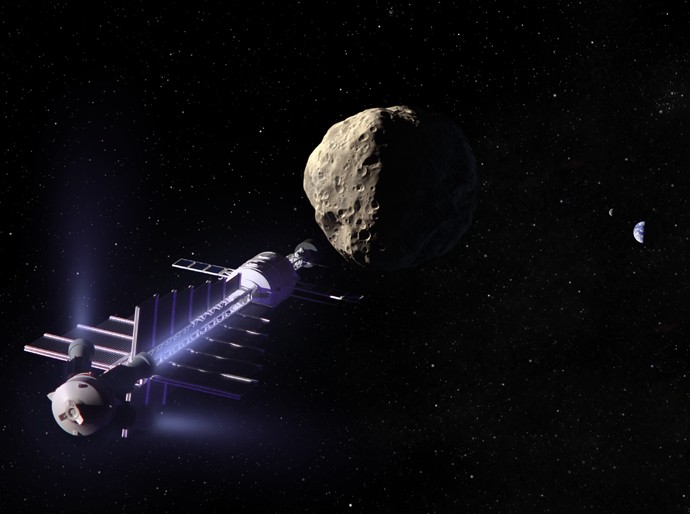
What many people, we have top sort of engineers and dynamicists working on – one problem, which is – involves what we call a gravitational tractor. A kind of a tractor beam where you send up a spaceship, bring it close to the asteroid, but not touch it, and you sort of park it there. And what I mean by – both of these are moving through space so when I say park, I mean you match velocities with the asteroid. And their mutual gravity will want to attract them to each other. And as they drift, you say, no, I'm not going to let that happen. So, you put on the little retro rockets on the rocket to prevent them from colliding. The act of doing that effectively tugs the asteroid out of harm's way. Because all you really want to do is move it so that it will not hit Earth in its trajectory. It'll still be out there, its orbit will still cross the orbit of the Earth, but you've lived to enjoy another day."
Neill DeGrasse Tyson on the radio show, Living on Earth. Listen to the show or read the full transcript here.