Showing posts with label natural disaster. Show all posts
Showing posts with label natural disaster. Show all posts
Monday, February 8, 2010
Kimberly Rivers Roberts performing in Trouble The Water
From the Oscar-nominated documentary film, Trouble the Water.


Tuesday, January 19, 2010
Haiti Earthquake
This morning, I received a touching message from a Haitian-American friend. I'd like to share some of it with you:
I have felt paralyzed this week: frozen, far away, unable to do anything but watch, wait, and call my family. I wish I had the expertise to be of service, to be of some use. I given up on T.V. it makes me feel more distant, and voyeuristic. I'm tired of the Anderson Coopers of the media trying to give "great coverage." Done with the same shocking picture plastered on every website. There are 2 million stories to tell and somehow every news agency is focusing on the same two. A couple of of exceptions: The Miami Herald has been better than most, The Lede Blog at the New York Times has had constant updates and links, and most impressively and heroically is the Haitian newspaper Le Nouveliste: their website is amazing (http://www.lenouvelliste.com/, in French and Kreyol) the videos are the most enlightening videos I have seen yet: the city appears remarkably calm, and he goes to many parts of the city. As opposed to the CNN super close ups of horror, Le Nouveliste is showing the real Haitian response: firm, calm, and reasonable. Watch the videos! They play one after another and he interviews priests, people leaving the city, and gives coverage to the new reality of living in Pap (Port-au-Prince). Even if you don't understand Kreyol it is the best out there. He interviews several Haitian students leading the search rescue at Quisqueya University (where my uncle was a professor), no foreigners and they saved and delivered to medical services 14 students. The interviewer asks him who was helping him, and he answers matter of factly: "Zami'm"- my friends.
Many of you I'm sure have already donated, and I thank you for you thoughtfulness. Right now the most urgent need is money, and organizations like the Red Cross, Catholic Relief Services, and Partners in Health are the on the ground and working hard. The last two in particular have resources and people distributed throughout the country, an important factor as many Haitian are leaving Port-au-Prince for the the interior.
I ask that you consider encouraging your community to sponsor a Haitian Church as Haiti rebuilds. Haiti is a very religious country and has lost many of it places of worship: from the great Catholic Cathedral of the capitol to small store front evangelical churches, the people will need places to share in the blessings that must follow such tragedy.
As grandmother used to say: Men anpil chay pa lou- Where hands are many, the harvest is not heavy.
Saturday, January 9, 2010
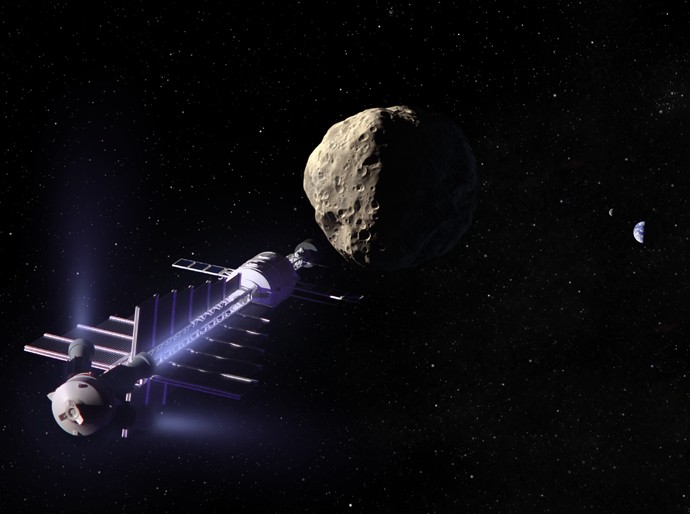
NDT: Using a Gravitational Tractor to Prevent a Meteor Strike
"You know the solar system's a shooting gallery. And Earth, many people don't know, plows through several hundred tons of meteors a day. So, the range of these that could hit us is huge.
Apophis – that was discovered in December 2004. It's an asteroid about the size of the Rose Bowl. If the Rose Bowl – imagine that as kind of like an eggcup, and you place something in it to hold it, that's about how big that asteroid is. That's not too shabby – that one, if it hits, it'll do some serious damage.
The first calculation showed that there was a real chance it could hit Earth in the year 2029 on April 13th. Which, by the way, happens to be a Friday.
As the months went by we had better orbital data and we determined that no, it will not hit us April 13th 2029, but it will come very close. It will come closer than Earth's orbiting communication satellites. It'll be the biggest, closest thing we've ever seen in the history of history. It'd be visible from northern Europe and it's basically – think of it as a shot across our bow. The universe saying, "I'll miss you this time, but I'll give you another chance to try to deflect me."
What many people, we have top sort of engineers and dynamicists working on – one problem, which is – involves what we call a gravitational tractor. A kind of a tractor beam where you send up a spaceship, bring it close to the asteroid, but not touch it, and you sort of park it there. And what I mean by – both of these are moving through space so when I say park, I mean you match velocities with the asteroid. And their mutual gravity will want to attract them to each other. And as they drift, you say, no, I'm not going to let that happen. So, you put on the little retro rockets on the rocket to prevent them from colliding. The act of doing that effectively tugs the asteroid out of harm's way. Because all you really want to do is move it so that it will not hit Earth in its trajectory. It'll still be out there, its orbit will still cross the orbit of the Earth, but you've lived to enjoy another day."
Neill DeGrasse Tyson on the radio show, Living on Earth. Listen to the show or read the full transcript here.
Subscribe to:
Posts (Atom)