Showing posts with label hang gliding. Show all posts
Showing posts with label hang gliding. Show all posts
Tuesday, September 6, 2011


Saturday, April 17, 2010
Wednesday, April 14, 2010
The Road to Recovery
A week and a half has passed since my accident. On Sunday, my friend (and M.D.) Bing removed the stitches under my chin. On Wednesday, Cleanpants and I replaced the basetube and downtube on my glider. It still needs to be flight checked by an instructor, but it looks like it's ready to fly again. As for me...I'm still a bit sore, particularly the ribs on the right side of my chest, but I think I'll be able to start exercising (and flying) again next week.
Here are a few pics from Soggy Bottom's photostream:


Here are a few pics from Soggy Bottom's photostream:
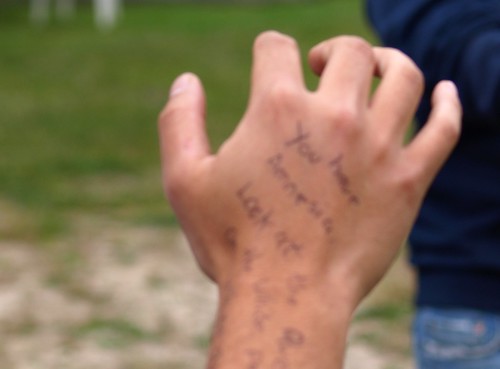
"You have amnesia. Look at the paper in your pocket before you ask any questions."
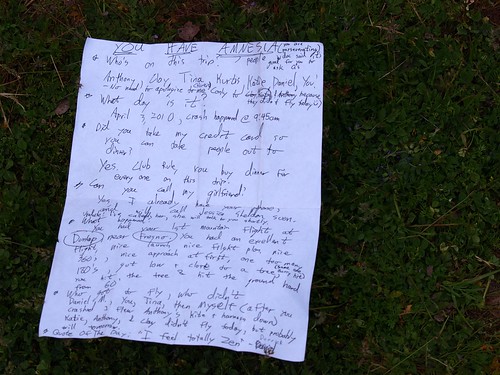
A list of FAQ I carried around until I got my memory back.
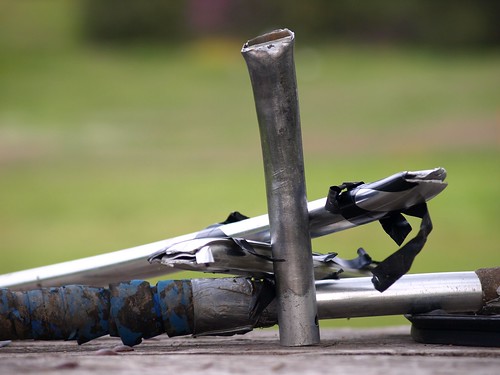
Broken basetube and downtube. Better the glider than me.

Dunlap at sunset
Tuesday, April 6, 2010
Factory Made: Hang Gliders
Discovery Channel - Factory Made ep. 6 from Søren Ladegaard on Vimeo.
The Discovery Channel films the construction of a T2C glider inside a Wills Wing factory.
Monday, April 5, 2010
Dunlap Trip Report
My glider clipped a tree on my final approach to the landing zone on my first mountain flight in Dunlap, California. I was supposed to do S-turns (figure 8s) between two markers: a cluster of 150 ft. cottontail trees and a small tree-lined hill, both upwind of the LZ, to burn off enough altitude and land cleanly in the field.
I ended up performing one too many turns. I flew too low on my final turn and clipped one of the trees with my wing tip. I fell twenty feet to the ground. When Daniel M. arrived at the scene, I wasn’t breathing. My instructor Kurtis, who had launched me from the top of the mountain, witnessed the crash from above. He was ready to dial 911 and call in a helicopter to rescue me.
Daniel reported to Kurtis via radio that I took my first breath one minute after crashing. Soon, I was conscious and responsive, so Kurtis took Anthony’s glider and harness from the top and flew down to give me a full body check. Two things stood out: (1) I had amnesia. (2) My body had escaped the crash unscathed. The rest of the students drove down and Kurtis, Anthony, and Clay took Kurtis’ truck and took me to the regional hospital in Fresno, about an hour away.

At the hospital, I had CT scans of my head, chest, and pelvis. They all turned out negative. The doctors in the ED had never witnessed head trauma without any concurrent body injuries. Even though I couldn't remember conversations for more than a few seconds, I claimed to be free of pain and was perfectly lucid. The physician diagnosed me with a concussion, stitched up a cut underneath my chin, and prescribed some painkillers for my headache and bruised chest before releasing me that same day.
I don’t have any memory of my flight, crash, or visit to the hospital. My memory “rebooted” at the restaurant in Pinehurst, where I treated everyone to dinner (a BHGC tradition: you crash, you buy everyone dinner). Almost all of my memory is back now, but I will probably never remember my flight, crash, or visit to the hospital.
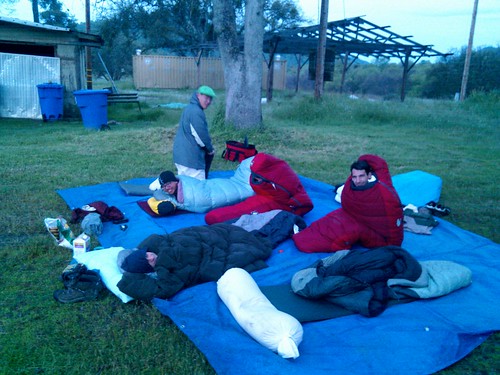
Even though I can’t remember my flight, I know some of the mistakes that may have contributed to my crash. (1) My body was poorly rested. I had run a marathon less than a week ago, and 16 miles on top of that just one day before my flight. (2) My mind was poorly rested. All seven of us on the trip slept on a tarp outside “like a pod of walruses.” Someone started snoring immediately, and shifted throughout the night to keep me awake. I probably slept less than 4 hours that night. (3) I didn’t see the flight plan. Daniel M. demonstrated the flight first, but I was stuck behind a few other students with my glider and I couldn’t see him fly. I flew right after Daniel, because the conditions were best for the person with the least experience -- me. (4) I was worried about overshooting the landing zone. I thought I had to be below tree height to bring my glider down into the LZ. I was overly concerned about overshooting the LZ and crashing into the fence or power lines behind the pasture. (5) I adjusted my harness a few days before the trip without testing it out. Anthony and I took out the delimiter on my harness, so that I flew more horizontal when I was kicked in to the harness. I should have taken a few test flights at lower altitudes before going to the mountains. (6) I was willing to overlook all of these concerns because I was excited about getting my first mountain flight under my belt.

I come out of this entire experience remarkably fortunate and thankful. My glider, helmet, harness, and reserve parachute took the brunt of the fall, and left me intact. The BHGC took care of me in the hours and days following my accident, and I know I've been in good hands ever since.
As soon as my injuries heal, I plan on being in the mountains flying again. I know that I am capable of being a safe and skilled pilot. I just need to incorporate the lessons that I have learned and avoid making the same mistakes.

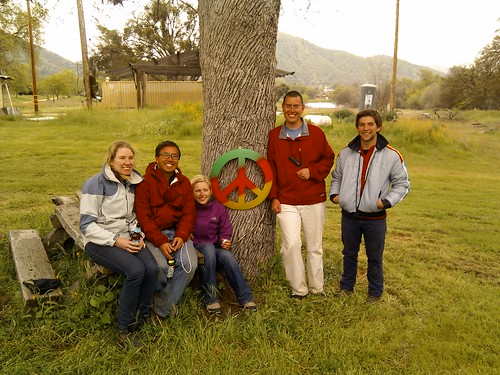
Update: Read Soggy Bottom's trip report here.
Update #2: There's a short video of me at the hospital, asking questions while "perseverating." Check it out here.
I ended up performing one too many turns. I flew too low on my final turn and clipped one of the trees with my wing tip. I fell twenty feet to the ground. When Daniel M. arrived at the scene, I wasn’t breathing. My instructor Kurtis, who had launched me from the top of the mountain, witnessed the crash from above. He was ready to dial 911 and call in a helicopter to rescue me.
Daniel reported to Kurtis via radio that I took my first breath one minute after crashing. Soon, I was conscious and responsive, so Kurtis took Anthony’s glider and harness from the top and flew down to give me a full body check. Two things stood out: (1) I had amnesia. (2) My body had escaped the crash unscathed. The rest of the students drove down and Kurtis, Anthony, and Clay took Kurtis’ truck and took me to the regional hospital in Fresno, about an hour away.

At the hospital, I had CT scans of my head, chest, and pelvis. They all turned out negative. The doctors in the ED had never witnessed head trauma without any concurrent body injuries. Even though I couldn't remember conversations for more than a few seconds, I claimed to be free of pain and was perfectly lucid. The physician diagnosed me with a concussion, stitched up a cut underneath my chin, and prescribed some painkillers for my headache and bruised chest before releasing me that same day.
I don’t have any memory of my flight, crash, or visit to the hospital. My memory “rebooted” at the restaurant in Pinehurst, where I treated everyone to dinner (a BHGC tradition: you crash, you buy everyone dinner). Almost all of my memory is back now, but I will probably never remember my flight, crash, or visit to the hospital.
Even though I can’t remember my flight, I know some of the mistakes that may have contributed to my crash. (1) My body was poorly rested. I had run a marathon less than a week ago, and 16 miles on top of that just one day before my flight. (2) My mind was poorly rested. All seven of us on the trip slept on a tarp outside “like a pod of walruses.” Someone started snoring immediately, and shifted throughout the night to keep me awake. I probably slept less than 4 hours that night. (3) I didn’t see the flight plan. Daniel M. demonstrated the flight first, but I was stuck behind a few other students with my glider and I couldn’t see him fly. I flew right after Daniel, because the conditions were best for the person with the least experience -- me. (4) I was worried about overshooting the landing zone. I thought I had to be below tree height to bring my glider down into the LZ. I was overly concerned about overshooting the LZ and crashing into the fence or power lines behind the pasture. (5) I adjusted my harness a few days before the trip without testing it out. Anthony and I took out the delimiter on my harness, so that I flew more horizontal when I was kicked in to the harness. I should have taken a few test flights at lower altitudes before going to the mountains. (6) I was willing to overlook all of these concerns because I was excited about getting my first mountain flight under my belt.
I come out of this entire experience remarkably fortunate and thankful. My glider, helmet, harness, and reserve parachute took the brunt of the fall, and left me intact. The BHGC took care of me in the hours and days following my accident, and I know I've been in good hands ever since.
As soon as my injuries heal, I plan on being in the mountains flying again. I know that I am capable of being a safe and skilled pilot. I just need to incorporate the lessons that I have learned and avoid making the same mistakes.
Update: Read Soggy Bottom's trip report here.
Update #2: There's a short video of me at the hospital, asking questions while "perseverating." Check it out here.
Tuesday, March 30, 2010
NorCal Free Flight Film Festival
I love NorCal.
View all the films from the film festival here.
NorCal FreeFlight Film Festival from Jose Pruneda on Vimeo.
2009 Year in Review from Charley Kurlinkus on Vimeo.
View all the films from the film festival here.
Sunday, March 21, 2010
My First Altitude Flights off the Top of Ed Levin
After 3 weeks of waiting for the winds to align, I had 3 flights off the 1750' hill in Ed Levin County Park yesterday. The air was light S/SW all day, between 4-10 mph -- perfect for a novice like me to fly at altitude for 20-25 minutes.
I also completed both tasks required by the Berkeley Club to fly in the mountains: performing stalls and 360s. A stalled glider stops flying because its nose is pointed too high and/or the glider is flying too slow. It recovers by nosing down and plummeting towards the Earth -- a sensation that most pilots love (but a few fear and loathe). In either case, we are required to practice stalls to recognize the signs of a forthcoming stall and practice recovering. The other task is completing 360 degree turns, which help pilots stay in thermals or other areas of lift. Pilots need to find and stay within thermals to stay soaring in the mountains and prevent short sled runs directly to the landing zone (LZ). 360s need to be practiced at high altitude as well, because an inefficient turn can result in a dramatic loss of altitude.
Even though there's a huge payoff at the end, altitude flying requires a substantial commitment. All pilots need to have an H2 (novice) rating which requires completing practical skills and passing two written exams, complete three successive spot landings in the LZ, have 10 flights off the 600' hill, and most importantly, a veteran pilot willing to sponsor your flight. In addition, we need a prone harness (one that allows you to fly horizontally), a 2m hand-held radio, and reserve parachute (to deploy above 500' in an emergency). With the help of students, instructors, and fellow pilots in the Berkeley Club, Wings of Rogallo, and Sonoma Wings, I've been able to finally complete all of these tasks!
Hopefully, my next post will be about flying in Big Sur or a mountain in the Sierras :)
I also completed both tasks required by the Berkeley Club to fly in the mountains: performing stalls and 360s. A stalled glider stops flying because its nose is pointed too high and/or the glider is flying too slow. It recovers by nosing down and plummeting towards the Earth -- a sensation that most pilots love (but a few fear and loathe). In either case, we are required to practice stalls to recognize the signs of a forthcoming stall and practice recovering. The other task is completing 360 degree turns, which help pilots stay in thermals or other areas of lift. Pilots need to find and stay within thermals to stay soaring in the mountains and prevent short sled runs directly to the landing zone (LZ). 360s need to be practiced at high altitude as well, because an inefficient turn can result in a dramatic loss of altitude.
Even though there's a huge payoff at the end, altitude flying requires a substantial commitment. All pilots need to have an H2 (novice) rating which requires completing practical skills and passing two written exams, complete three successive spot landings in the LZ, have 10 flights off the 600' hill, and most importantly, a veteran pilot willing to sponsor your flight. In addition, we need a prone harness (one that allows you to fly horizontally), a 2m hand-held radio, and reserve parachute (to deploy above 500' in an emergency). With the help of students, instructors, and fellow pilots in the Berkeley Club, Wings of Rogallo, and Sonoma Wings, I've been able to finally complete all of these tasks!
Hopefully, my next post will be about flying in Big Sur or a mountain in the Sierras :)
Wednesday, January 6, 2010
Flying off the 600 ft. Hill
Here's a video of my first flight off the 600 ft. hill in over 10 months. I remember being scared (more than usual) for several reasons:
1) My friend Anthony mounted his HD camcorder on my glider for the first time, and I was a bit worried it might affect the glider's performance.
2) I was flying a new approach to the landing zone; making a 90 degree turn from the south instead of the typical west approach.
3) I was launching off the 600 ft. hill unassisted. Anthony had already flown off the 600 ft. hill moments before, and our flight instructor Barry was launching other students off the 300 ft. hill. That meant I had to make my own judgments and decisions on launch -- always a hairy proposition.
It ended being a pretty good flight. I ended up putting my knee on the base tube to bring the Pulse down as fast as I could, but I blew past the spot (the orange cones at the end) anyway. Lots of fun, can't way to do it again and fly off the top of the mountain at 1750 ft!
1) My friend Anthony mounted his HD camcorder on my glider for the first time, and I was a bit worried it might affect the glider's performance.
2) I was flying a new approach to the landing zone; making a 90 degree turn from the south instead of the typical west approach.
3) I was launching off the 600 ft. hill unassisted. Anthony had already flown off the 600 ft. hill moments before, and our flight instructor Barry was launching other students off the 300 ft. hill. That meant I had to make my own judgments and decisions on launch -- always a hairy proposition.
It ended being a pretty good flight. I ended up putting my knee on the base tube to bring the Pulse down as fast as I could, but I blew past the spot (the orange cones at the end) anyway. Lots of fun, can't way to do it again and fly off the top of the mountain at 1750 ft!
Monday, November 9, 2009
Land Skimming on the Pulse
Last Saturday, I transitioned to my first intermediate wing, the Pacific Airwave Pulse 9 meter.
Setting up a Pulse 9m is pretty similar to setting up a Falcon 140. The most important difference is to make sure the foam sitting under the wing's leading edge is not creased before tensioning the glider. The Pulse also has a nose cone, a detachable king post, and a few extra battens that are inserted underneath the wing, but those differences are impossible to overlook when you're setting up.
I launched my glider from the 40' hill. I belly landed my first flight and ran out the second. On my third flight, my instructor Justine noticed that I was pulling in after my launch. So the next time out, I let the glider fly at trim and promptly crashed. My right wing dipped into the hill shortly after take off and I was spun completely around. I cut my arm on the ground but fortunately the wing was undamaged.
Justine took a test flight in my glider and determined that the trim was set too slow. She adjusted my hang strap a quarter inch closer to the nose of the wing, and my next flight was perfect.
Afterwards, we tried to figure out why I couldn't sense the glider was trimmed improperly. Several variables probably affected my judgment: it was a post-frontal day at Ed Levin so the wind conditions were faster and more cross than normal, I was flying a glider I had never flown before, and I was running downhill strong enough to overcome any stalls.
Next time out, I want to take 3-4 more flights on the 40' or 50' hill and then advance up to higher altitudes. Then, I will hopefully be able to evaluate how the Pulse performs compared to the Falcon.
Setting up a Pulse 9m is pretty similar to setting up a Falcon 140. The most important difference is to make sure the foam sitting under the wing's leading edge is not creased before tensioning the glider. The Pulse also has a nose cone, a detachable king post, and a few extra battens that are inserted underneath the wing, but those differences are impossible to overlook when you're setting up.
I launched my glider from the 40' hill. I belly landed my first flight and ran out the second. On my third flight, my instructor Justine noticed that I was pulling in after my launch. So the next time out, I let the glider fly at trim and promptly crashed. My right wing dipped into the hill shortly after take off and I was spun completely around. I cut my arm on the ground but fortunately the wing was undamaged.
Justine took a test flight in my glider and determined that the trim was set too slow. She adjusted my hang strap a quarter inch closer to the nose of the wing, and my next flight was perfect.
Afterwards, we tried to figure out why I couldn't sense the glider was trimmed improperly. Several variables probably affected my judgment: it was a post-frontal day at Ed Levin so the wind conditions were faster and more cross than normal, I was flying a glider I had never flown before, and I was running downhill strong enough to overcome any stalls.
Next time out, I want to take 3-4 more flights on the 40' or 50' hill and then advance up to higher altitudes. Then, I will hopefully be able to evaluate how the Pulse performs compared to the Falcon.
Friday, September 11, 2009
Friday, March 20, 2009

Monday, January 19, 2009
Subscribe to:
Posts (Atom)