1. Get enough sleep.
2. Schedule stillness.
3. Move your body.
4. Connect with nature.
5. Strengthen your relationships.
6. Get in the zone.
7. Play more.
8. Be of service.
9. Express yourself.
From Psychcentral.
Showing posts with label health. Show all posts
Showing posts with label health. Show all posts
Friday, May 20, 2016


Tuesday, February 23, 2016
The Joy of Strength
Adapted from MMM:
Strength is at the root of most joy and weakness is at the root of most unhappiness in a person's life.
Here are a few of life’s most powerful sources of strength and weakness:
* Money is the most acknowledged source of strength in modern society, for it gives you the power to get other people to serve you, and to do so with a smile.
* An Abundance of Money is even more powerful.
* The Desire for Ever-Increasing Material Luxury is a serious weakness. You can never satisfy Luxury – there is always another level of fanciness to attain, and thus he can never have quite enough money.
* Giving is a form of strength. When you say, “I have more than I need, and thus my desire to take should fade away as my desire to help out grows”.
* Taking is therefore a form of weakness.
* Health is a form of strength.
* Physical Strength is the part of health that is mostly ignored in the United States, yet it is the most useful and efficient component.
* Skills are a form of strength. Each thing you learn to do improves your quality of life in astonishing ways, because it makes you stronger. If you are good at your job, you have the ability to earn lots of money. But if this is your only skill, you need to outsource your food preparation, transportation, relationships, entertainment, and the repair and maintenance of everything you own including your own body. If your money supply fails or your hired specialists don’t do their jobs perfectly, your life falters. By insourcing all the basics required for happiness, you build a self-reinforcing resilient mesh of power that makes you happier, wealthier, and more interesting as well.
* Voluntary Discomfort is the secret cornerstone of strength. We build our whole lives around increasing comfort and avoiding discomfort, and yet by doing so we are drinking a can of Weakness Tonic with every morning’s breakfast. Our entire culture teaches us to seek out all possible comforts, and to be unhappy when we don’t have them. And thus, it dooms us to a life of permanent involuntary discomfort, and therefore permanent weakness.
Lifestyle as Medicine
Dr. David Katz, the founding director of the Yale University Prevention Research Center, makes a compelling, evidence-based case that we should all be promoting six healthy habits:
1. Feet - Exercise regularly.
2. Forks - Eat well.
3. Fingers - Don't smoke.
4. Sleep - Get good sleep each night.
5. Stress - Reduce stress.
6. Love - Love and seek pleasure.
Dr. Katz cites this 2009 study in the Archives of Internal Medicine that finds (1) never smoking, (2) having a BMI < 30, (3) performing 3.5 hr/week of physical activity, and (4) adhering to healthy dietary principles (high intake of fruits, vegetables, and whole-grain breads and low meat consumption) results in a 78% lower risk of having a heart attack, stroke, diabetes, or cancer.
Read more here.
1. Feet - Exercise regularly.
2. Forks - Eat well.
3. Fingers - Don't smoke.
4. Sleep - Get good sleep each night.
5. Stress - Reduce stress.
6. Love - Love and seek pleasure.
Dr. Katz cites this 2009 study in the Archives of Internal Medicine that finds (1) never smoking, (2) having a BMI < 30, (3) performing 3.5 hr/week of physical activity, and (4) adhering to healthy dietary principles (high intake of fruits, vegetables, and whole-grain breads and low meat consumption) results in a 78% lower risk of having a heart attack, stroke, diabetes, or cancer.
Read more here.
Tuesday, February 9, 2016
Why is it so hard to lose weight?
If weight is simply a result of calories in minus calories out, why is it so difficult for so many people -- including me -- to lose weight? I think Michael Graziano makes a compelling case to view our obesity epidemic differently. Hunger, Graziano posits, is a mood that is difficult to control. Trying to lose weight by dieting is often counterproductive because it causes the hunger mood to rise. Instead, a person should focus on regulating his hunger mood.
As Bee Wilson states in her interview with Terry Gross on Fresh Air,
Perhaps the take home message is to tinker with our psychology so that we feel like hunger is actually a good thing because it'll benefit us in both the short and long term.
As Bee Wilson states in her interview with Terry Gross on Fresh Air,
I think the biggest thing that I learned above and beyond changing my preferences so that I liked vegetables more and liked things like pastries somewhat less was hunger management. I think we don't talk enough about this as a skill because it is something that you can learn to get better at. I used to panic if I felt the mildest rumblings of hunger, whereas now, if I know I've got a good meal coming in a couple of hours, I think, oh, I'm hungry. That's good. I'm going to enjoy the next meal more - more pleasure.
Perhaps the take home message is to tinker with our psychology so that we feel like hunger is actually a good thing because it'll benefit us in both the short and long term.
Tuesday, September 15, 2009
Conditional Parenting is Counterproductive
Author Alfie Kohn cites recent research that "conditional parenting" -- i.e., rewarding children with praise for desirable behavior and/or punishing them for undesirable behavior -- is counterproductive. Using a system of punishment and rewards does not promote moral development; instead, it increases negative feelings toward parents/teachers and promotes unhealthy emotions in a child, like anxiety, guilt, and shame.
Instead, parents/teachers should practice unconditional acceptance accompanied by "autonomy support": explaining reasons for requests, maximizing opportunities for the child to participate in making decisions, being encouraging without manipulating, and actively imagining how things look from the child’s point of view.
Kohn states, "Most of us would protest that of course we love our children without any strings attached. But what counts is how things look from the perspective of the children — whether they feel just as loved when they mess up or fall short."
Read the full article at the New York Times.
Instead, parents/teachers should practice unconditional acceptance accompanied by "autonomy support": explaining reasons for requests, maximizing opportunities for the child to participate in making decisions, being encouraging without manipulating, and actively imagining how things look from the child’s point of view.
Kohn states, "Most of us would protest that of course we love our children without any strings attached. But what counts is how things look from the perspective of the children — whether they feel just as loved when they mess up or fall short."
Read the full article at the New York Times.
Monday, February 2, 2009
Recess Improves Third Graders' Behavior
According to teachers' ratings, 15 minutes of recess improves the classroom behavior of third graders. (>15 minutes recess showed no measurable improvement.) The study, conducted by the Dept. of Pediatrics at the Albert Eintstein School of Medicine, used public data from 11,000 students. The researchers also found that students with no recess were "much more likely to be black, to be from families with lower incomes and lower levels of education, to live in large cities, to be from the Northeast or South, and to attend public school."
Read the abstract in the journal Pediatrics, or the NYT article .
Read the abstract in the journal Pediatrics, or the NYT article .
Tuesday, January 27, 2009
Are we too clean?
A baby cannot resist stuffing anything within reach into her mouths, often to the chagrin of her paranoid parents.
Biologists are studying why a baby's instinctive behavior -- specifically, stuffing dirt into her mouth -- would be in fact beneficial. They propose a 'hygiene hypothesis," eating dirt and the billions of microbes and, yes, worms inside that dirt may sicken the child (and parent) in the short term, but will reduce the chance of developing immune-related illnesses in the long run.
According to immunologist Mary Ruebush, children raised in a hyper-clean environment are not exposed to the organisms that help them develop appropriate immune circuits. Research suggests that the increase in immune system disorders (e.g., asthma, allergies, multiple sclerosis, Type I diabetes, and inflammatory bowel disease) in the US may be due to our restrictions on the environment and behavior of our children.
Dr. David Elliott of the University of Iowa cites specific evidence in developing countries; for example, he claims that the eradication of worms in some villages in Gambia have led to an increase in children's skin allergies.
Obviously, dirtiness is not a desirable outcome. But too much cleanliness is harmful, too. Professor Ruebrush suggests that we rue antibiotic products and stick with plain soap and water whenever our hands need washing. Dr. Joel Weinstock of Tufts Medical Center goes even further: “Children should be allowed to go barefoot in the dirt, play in the dirt, and not have to wash their hands when they come in to eat." He also suggests that kids have two dogs and a cat, which will expose them to intestinal worms that can promote a healthy immune system.
Read the NYT article here.
9/17/09 Update:
 A man infects himself with hookworm to cure his asthma and hayfever. Listen to his account on Radiolab (his story begins at ~32 minute mark in the show).
This cute little bloodsucker can cure your asthma.
Biologists are studying why a baby's instinctive behavior -- specifically, stuffing dirt into her mouth -- would be in fact beneficial. They propose a 'hygiene hypothesis," eating dirt and the billions of microbes and, yes, worms inside that dirt may sicken the child (and parent) in the short term, but will reduce the chance of developing immune-related illnesses in the long run.
According to immunologist Mary Ruebush, children raised in a hyper-clean environment are not exposed to the organisms that help them develop appropriate immune circuits. Research suggests that the increase in immune system disorders (e.g., asthma, allergies, multiple sclerosis, Type I diabetes, and inflammatory bowel disease) in the US may be due to our restrictions on the environment and behavior of our children.
Dr. David Elliott of the University of Iowa cites specific evidence in developing countries; for example, he claims that the eradication of worms in some villages in Gambia have led to an increase in children's skin allergies.
Obviously, dirtiness is not a desirable outcome. But too much cleanliness is harmful, too. Professor Ruebrush suggests that we rue antibiotic products and stick with plain soap and water whenever our hands need washing. Dr. Joel Weinstock of Tufts Medical Center goes even further: “Children should be allowed to go barefoot in the dirt, play in the dirt, and not have to wash their hands when they come in to eat." He also suggests that kids have two dogs and a cat, which will expose them to intestinal worms that can promote a healthy immune system.
Read the NYT article here.
9/17/09 Update:
 A man infects himself with hookworm to cure his asthma and hayfever. Listen to his account on Radiolab (his story begins at ~32 minute mark in the show).
 This cute little bloodsucker can cure your asthma.
Sunday, January 25, 2009
What if?
Imagine a women’s magazine that positively featured round models, short models, old models – or no models at all, but real individual women. Let’s say that it had a policy of avoiding cruelty to women, as some now have a policy of endorsing products made free of cruelty to animals. And that it left out crash diets, mantras to achieve self-hatred, and promotional articles for the procession that cuts open healthy women’s bodies. And let’s say that it ran articles in praise of the magnificence of visible age, displayed loving photo essays on the bodies of women of all shapes and proportions, examined with gentle curiosity the body’s changes after birth and breast-feeding, offered recipes without punishment or guilt, and ran seductive portraits of men.
It would run aground, losing the bulk of its advertisers. Magazines, consciously or half-consciously, must project the attitude that looking one’s age is bad because $650 million of their ad revenue comes from people who would go out of business if visible age looked good. They need, consciously or not, to promote women’s hating their bodies enough to profitably hungry, since the advertising budget for one third of the nation’s food bill depends on their doing so by dieting. The advertisers who make women’s mass culture possible depend on making women feel bad enough about their faces and bodies to spend more money on worthless or pain-inducing products than they would if they felt innately beautiful.
from The Beauty Myth (1991) by Naomi Wolf
Tuesday, January 13, 2009
Friday, January 2, 2009
The Downside of Pornography
Naomi Wolf deconstructs the "Porn Myth" in New York magazine:
Young men and women are indeed being taught what sex is, how it looks, what its etiquette and expectations are, by pornographic training—and this is having a huge effect on how they interact.
But does all this sexual imagery in the air mean that sex has been liberated—or is it the case that the relationship between the multi-billion-dollar porn industry, compulsiveness, and sexual appetite has become like the relationship between agribusiness, processed foods, supersize portions, and obesity? If your appetite is stimulated and fed by poor-quality material, it takes more junk to fill you up. People are not closer because of porn but further apart; people are not more turned on in their daily lives but less so.
The onslaught of porn is responsible for deadening male libido in relation to real women, and leading men to see fewer and fewer women as “porn-worthy.”
The reason to turn off the porn might become, to thoughtful people, not a moral one but, in a way, a physical- and emotional-health one; you might want to rethink your constant access to porn in the same way that, if you want to be an athlete, you rethink your smoking. The evidence is in: Greater supply of the stimulant equals diminished capacity.
Sunday, December 14, 2008
Satish Kumar, Jain monk and environmental activist
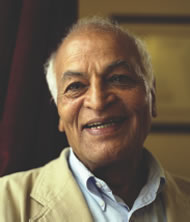 The following is a transcript of a converation with Satish Kumar on the PRI program, To the Best of Our Knowledge (Listen to the interview yourself here):
How about going on a pilgrimage, and walking 8,000 miles barefoot across India. When he was only nine years old, Satish Kumar joined the wandering brotherhood of Jain monks in his native India. At 18, he became a campaigner for land reform and one of Gandhi's followers. To protest the nuclear arms race, he made an 8,000 mile peace pilgrimage, walking from India to America, without any money. Years later, he did it again, celebrating his 50th birthday by walking 2,000 miles with no money around Great Britain. Now in his 70s, Satish Kumar is one of the leading voices bringing together spirituality and ecology. He's the editor of Resurgence magazine and the founder of Schumacher College in England. Steve Paulson sat down with Mr. Kumar recently and asked how his spiritual values have informed his life.
Steve Paulson: When you were nine years old, you joined the wandering brotherhood of Jain monks, and you stayed a monk until you were 18. What did those years living as a monk teach you about nature?
When I was a monk, I meditated upon nature. I would go out in nature, and stand under a tree because I would remember that even the Buddha learned from the tree. He was enlightened while sitting under a tree, because when you are standing or sitting under a tree, you can see how all life is connected. The rain is falling and nourishing the tree roots. The birds are coming and sitting on the tree. The seeds are falling and giving fruit and food and nourishment to the worms. Worms are making the land fertile and nourishing the tree. So how, the cycle of life and the connectivity of life, how it is all together, how the interrelationship of all living beings act, I learn by standing and meditating under a tree.
SP: I wonder if there is something about Jainism, about this religious order that you joined that let you into some of these insights.
The specific quality of Jain religion is adherence and its belief in nonviolence. There is no other religion greater than nonviolence. So as a Jain, I will not even wear shoes, because if you are wearing shoes you might tread on some creatures on the earth, and they might get hurt. Whereas the feet are soft, and even if I am walking bare feet, I will look down watching the earth, so I don't tread on any creatures. And, if at night I'm walking, I'll have a little brush in my hand, and I'll sweep the floor before I put my foot down. So this way, Jains practice nonviolence to its extreme level, and that's what I love. And so nonviolence to nature, my nonviolent ecology, came from Jain ecology.
SP: Let me ask you more about walking, because you've spent years walking. I mean, I know you went on pilgrimages in various points in your life. You would walk across an entire continent. It sounds like you're saying that walking can have real spiritual significance.
Absolutely. For when you are walking, you are touching the earth. When you are touching the earth, you feel a sense of belonging to the earth. And earth is holding you, earth is sustaining you, and walking becomes a spiritual practice. This is why all great religious teachers have gone on pilgrimages because walking is the best form of meditation and best form of relationship with the natural world, the earth, the trees, the air, the sunshine, with the whole, whole existence. And so walking is a beautiful and a very high form of spiritual practice.
SP: I'm surprised that you didn't also say that it forces you to slow down, that you can't go too fast.
Spirituality and speed don't go together. The very fact that you are walking, you have to go slowly and you have to believe that when God made time, he made plenty of it. There is no shortage of time. You don't have to get somewhere quickly. Getting somewhere is not as important as how you get there. So the process of living, the process of walking, is more important. This is why I call my autobiography, No Destination, because when you are obsessed with reaching somewhere, you take any means of travel. But when journey itself becomes important, then you realize that not only this walking, where you are going somewhere, the life itself is the journey.
SP: Well, I have to ask you about this because you are not a monk anymore, living in England you edit a magazine, you teach at a college, you give talks around the world, it sounds like it can be very demanding. I'm wondering how much you can incorporate these principles of slowness and walking and not venturing too far off, how much that you can incorporate all that into your own life.
All those things I do slowly. I get up in the morning and I spend an hour reading spiritual scripts, I spend at least half an hour doing yoga and meditation every day. And then I have a siesta after lunch at least half an hour, so whatever work I'm doing, editing a magazine, or lecturing, or whatever work I'm doing, I'm never hurried. The quality of your work is more important then the speed and quantity of your work. So I always shift my consciousness from quantity to quality.
SP: Do you end up saying no a lot, when people ask you to do things?
Um, yes, to some extent I have to say no because if somebody's asking me to go to a conference, and I'm already doing something else in my diary, then I will have to say no. But I try to say yes as much as I can because I like to honor people's requests and people's invitation. So, I do it with a very light, light sort of foot. I don't feel any kind of stress or strain when I do something. I do slowly, and I do with love and with care, and that way I can live simple and slow life.
SP: I'm trying to figure out how you manage to do this when I can't, and so many other people can't. I mean, for me it seems to be this, this test to see if I can fit everything that I seem to need to do into a day.
I do only one thing at a time. When I'm doing that thing, I'm doing only that thing at that time. I'm not doing anything, I'm not thinking about anything else that I have to do too much other things. I will do what I am doing fully, totally present in that moment, and when I finish doing that, then whatever next comes, I will do that fully and totally at that moment. So I live in the moment, in the here and now, every moment is a very beautiful moment and my full concentration, full attention, full mindfulness is there. And that way, I don't feel any stress. I don't think that I have to do too much. I have a day, a whole day, time is always coming, I have plenty of time to come, and plenty of time to do things and if I don't accomplish everything in this life, there's a next life. So I...
SP: [Laughing] So are you saying you don't have any stress in your life?
No stress.
SP: No stress at all?
No stress at all. Because if you are living in the moment, in the here and now, and everything you do is a work of spiritual practice, and a work of art, then there is no stress. When you are painting a picture, you can't feel stress because this is what you want to do. If you are writing a poem, you can't feel stress because this is what you want to do. So I do only what I want to do, and when I do it, I do it with imagination, with mindfulness, with slowness and with creativity, with imagination and with full presence and mindfulness. And there's no stress. Stress is because we are worried, "Am I going to achieve?" I'm not trying to achieve anything. There's nothing to achieve. Action in itself is its own reward.
SP: Doesn't success also come from trying to do certain things, to take responsiblity. I mean maybe you have a job most of the day, you have children and you have all kinds of responsiblities there. I'm just trying to think of how some of what you're talking about applies to the typical American lifestyle.
I do things without doing them. I'm not the doer. Things are happening through me, but I am not the doer. I don't take any burden of the action. Action is naturally flowing through me so, like children come through you not from you, Khalil Gibran said. In the same way, actions and words come through you. I'm speaking to you now. These words are coming through me, I'm not taking any kind of ownership, or worry, or I'm not in any stress, I'm not in any hurry. I'm just speaking in a nice, relaxed way. So this way, I do every action, and there is no need to have any stress. I'm not interested in any outcome, I'm not interested in any achievement, I'm not trying to get somewhere. I'm not trying to succeed in my life. My life is not about success, my life is about self-realization and fulfillment. And if we seek fulfillment, we'll have no stress. If we seek success, we will have stress.
SP: As you look around the world right now, you are an activist, and you campaign for the principles of simplicity. You're shaking your head. You don't do that?
I am, but not in a kind of visionary way. I'm not trying to preach anything. And I'm not saying that people must listen to me, and follow me, and they must change as I want them to change. Like you plant a seed, and the planting the seed is your action. After that, the seed will grow by itself. And your work is to water the seed maybe. So what I am doing in my mission, and it's not really a mission, in my work when I'm trying to promote simplicity, sustainabilty, nonviolence, peace, all these things are like watering the seed. The tree will grow by itself. The seed knows how to become a tree. I don't have to tell people to be peaceful. People know how to be peaceful. I am only there to encourage them, to remind them to water the seeds of peace in their heart. That's all I'm doing and if the peace does not grow, then too bad. I'm not taking any responsiblity. So you can say I'm very irresponsible in that way. But I don't want to take the burden of the world on my shoulders. I'm not God, I'm not shaping the whole world. It's not my responsiblity to change the whole world. I'm here not to change the world, but to serve the world. When you want to change the world, you take a burden of changing and responsiblity of changing. And that can be stressful. When you are serving the world, you do your best and that's it.
Thursday, September 25, 2008
Wednesday, September 17, 2008
Encouraging Healthy Eating Habits
Wednesday, June 18, 2008
Dry or Wet Earwax?
When I was young, I always wondered why they called the gunk in your ear "wax." My ear wax has always been powdery, and today I discovered that I'm not alone.
Unlike other ethnicities, most East Asians have a mutation that make their ear wax dry and flaky. Eureka.
Read the Live Science article here and the New York Times article here.
Unlike other ethnicities, most East Asians have a mutation that make their ear wax dry and flaky. Eureka.
Read the Live Science article here and the New York Times article here.
Tuesday, June 17, 2008
Ben Kingsley on Adolescence
"I think youth has become very tangled up with consumerism. And I think the very extraordinary years that we call adolescence, moving from childhood to adulthood, they're very fleeting. And, I don't recall my adolescence being so consumer driven, so constantly invaded by peer pressure, fashion, gossip, uhhh very transient musical fashions and tastes, clothes, uh umm role models. It seems to be very cluttered, and adolescence is hard enough without a whole multibillion dollar consumer industry jumping on the backs of adolescence and making them, and squeezing them, squeezing dollars out of them. Well in fact, the reverse should be happening, that we should as an adult society, be squeezing encouragement into them and decent values into them and beautiful thoughts and ideas into them. No, we just want their money. It's pathetic, and I think somewhere in this story and in the dynamic, in the essentials of adolescence being a necessary time for experiment...But at the heart of it is, in order to grow, you have to make mistakes, you must be reckless, you cannot follow the herd, you have to follow your heart, you have to, to quote my crazy character, end up face down in the gutter, get your heart broken, make a mess of things because that is what adolescence is. And it's self healing. We make a mess as adolescents and it's self healing. Unless of course we stray into narcotics which will kill us or into alcohol which will kill us or into any kind of very compulsive destructive behavior but we are constantly, adolescents are constantly invited to be constant consumers. So it's a little unfair to expect adolescents to be free of certain substances, eating disorders, drug disorders, alcohol disorders and at the same time say but you do have to consume. It's very unfair of them, you know."
Watch the video of Ben Kingsley on the June 17, 2008 taping of the Tavis Smiley Show here.
Watch the trailer for Ben Kingsley's new movie The Wackness here.
Watch an example of rampant childhood consumerism here.
Watch the video of Ben Kingsley on the June 17, 2008 taping of the Tavis Smiley Show here.
Watch the trailer for Ben Kingsley's new movie The Wackness here.
Watch an example of rampant childhood consumerism here.
Thursday, June 12, 2008
Suicide Prevention Workshop
When students have a half day, teachers have to stay after school and attend class. Today, we had a suicide prevention workshop. A well-respected physician from Montefiore Medical Center came in and talked about suicide among adolescents. Certainly a grim but important topic.
A few highlights from today's lecture:
1. Suicide rates increase with age. There are virtually no suicides among children younger than 10 and very little among middle schoolers. The suicide rate begins to climb steadily from high school onwards. Senior citizens have the highest rate of suicide -- it's just not publicized because it's the 25th leading cause of death among the elderly. On the other hand, suicide is the 3rd leading cause of death in the United States among those aged 15-24 (behind accidents and homicide).
2. Suicides can happen in waves. A single suicide can spark copycats throughout a community. Therefore, it's very important how leaders in the community handle these crises -- drawing lots of media and community attention may be unhealthy for others going through problems of their own.
3. Boys are four times more likely to succeed in a suicide attempt than girls. The common perception is that girls are more dramatic than boys and attempt suicide to not kill themselves but to draw attention. This, at best, is a partial truth. Rather, girls are much more likely to attempt suicide by digesting pills and boys are much more likely to use more violent and effective methods. It's much easier for a physician to save a patient who overdoses on drugs than it is to save a patient who shoots him/herself.
4. Girls are four times more likely to attempt suicide than boys. The risk factors leading to suicide among teens -- family disruption, substance/sexual abuse, gay/lesbian sexual orientation -- lead to feelings of powerlessness in our society. Girls, I believe, have less avenues to excise these feelings and are therefore more likely to act out on their own bodies (e.g., cutting, anorexia, bulimia, and suicide) than boys.
So, what do we do? The support system in the Bronx is woefully inadequate -- our speaker today acknowledged that the medical system here does "triage" -- since there are an overwhelming number of individuals who need help, doctors attend only to the worst cases. Really, it's up to the rest of us -- friends, family, teachers, etc. -- to look out for our own.
A few highlights from today's lecture:
1. Suicide rates increase with age. There are virtually no suicides among children younger than 10 and very little among middle schoolers. The suicide rate begins to climb steadily from high school onwards. Senior citizens have the highest rate of suicide -- it's just not publicized because it's the 25th leading cause of death among the elderly. On the other hand, suicide is the 3rd leading cause of death in the United States among those aged 15-24 (behind accidents and homicide).
2. Suicides can happen in waves. A single suicide can spark copycats throughout a community. Therefore, it's very important how leaders in the community handle these crises -- drawing lots of media and community attention may be unhealthy for others going through problems of their own.
3. Boys are four times more likely to succeed in a suicide attempt than girls. The common perception is that girls are more dramatic than boys and attempt suicide to not kill themselves but to draw attention. This, at best, is a partial truth. Rather, girls are much more likely to attempt suicide by digesting pills and boys are much more likely to use more violent and effective methods. It's much easier for a physician to save a patient who overdoses on drugs than it is to save a patient who shoots him/herself.
4. Girls are four times more likely to attempt suicide than boys. The risk factors leading to suicide among teens -- family disruption, substance/sexual abuse, gay/lesbian sexual orientation -- lead to feelings of powerlessness in our society. Girls, I believe, have less avenues to excise these feelings and are therefore more likely to act out on their own bodies (e.g., cutting, anorexia, bulimia, and suicide) than boys.
So, what do we do? The support system in the Bronx is woefully inadequate -- our speaker today acknowledged that the medical system here does "triage" -- since there are an overwhelming number of individuals who need help, doctors attend only to the worst cases. Really, it's up to the rest of us -- friends, family, teachers, etc. -- to look out for our own.
Sunday, November 18, 2007
Untidy Beds May Keep Us Healthy
 Don't like making your bed? Use science to justify your sloth!
According to the BBC, a new study suggests that unmade beds are less habitable by house dust mites. These pesty dust mites are thought to cause problems like allergies and asthma. The theory is that unmade beds dry sheets and mattresses better than made beds; made beds tend to be warmer and moister, ideal conditions for dust mite habitation.
"Something as simple as leaving a bed unmade during the day can remove moisture from the sheets and mattress so the mites will dehydrate and eventually die," Dr Stephen Pretlove said.
Read the BBC article here: http://news.bbc.co.uk/2/hi/health/4181629.stm
Monday, June 11, 2007
Thursday, April 5, 2007
NYC's HIV/AIDS Epidemic
The truth is scary.
Did you know that New York City has the highest AIDS case rate in the country? There are more people in NYC living with AIDS then Los Angeles, San Francisco, Miami, and Washington DC combined!
And HIV is an acute problem in our communities: four out of five (80%) new AIDS diagnoses and deaths are among African Americans and Hispanics.
Here are some suggestions to protect yourself:
1) Be informed. Learn what HIV/AIDS is and how it is transmitted.
2) Avoid risky (i.e., stupid) behaviors. Do not have sex until you are ready and it is with a person you trust. And never have unprotected sex, even with a steady partner -- many boyfriends and girlfriends are unknowingly spreading the disease.
3) If you're sexually active, get tested. An early diagnosis can mean the difference between life and death -- for you and your loved ones.
Questions? More info and links can be found at The Dept.of Health and Mental Hygiene's HIV/AIDS homepage. Or talk to Ms. Caroline, myself, or an adult you trust.
Did you know that New York City has the highest AIDS case rate in the country? There are more people in NYC living with AIDS then Los Angeles, San Francisco, Miami, and Washington DC combined!
And HIV is an acute problem in our communities: four out of five (80%) new AIDS diagnoses and deaths are among African Americans and Hispanics.
Here are some suggestions to protect yourself:
1) Be informed. Learn what HIV/AIDS is and how it is transmitted.
2) Avoid risky (i.e., stupid) behaviors. Do not have sex until you are ready and it is with a person you trust. And never have unprotected sex, even with a steady partner -- many boyfriends and girlfriends are unknowingly spreading the disease.
3) If you're sexually active, get tested. An early diagnosis can mean the difference between life and death -- for you and your loved ones.
Questions? More info and links can be found at The Dept.of Health and Mental Hygiene's HIV/AIDS homepage. Or talk to Ms. Caroline, myself, or an adult you trust.
Wednesday, March 14, 2007
Asthma in the South Bronx
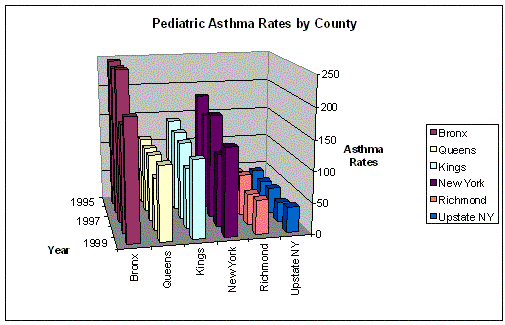
Recently, I learned that Harlem & the South Bronx have one of the highest rates of asthma in the nation. The illness particularly affects kids: in the U.S., asthma is the number one cause of school absences each year.
Why do so many kids in our area have asthma? Experts aren't sure, but many attribute it to pollution.
Here's an excerpt taken from an article written by Natalie Olivero in the Gotham Gazette:
Communities like East Harlem are burdened with polluting facilities, like a multi-storied diesel bus depot operated by the New York City Transit Authority, a sanitation truck depot, and a sewage treatment plant on Ward’s Island,” said Yolande Cadore, organizing director of the environmental justice group West Harlem Environmental Action, Inc. ( WE ACT), in an email. “These communities bear the burden of high asthmas rates, lung and heart disease, obesity and diabetes.
Why does pollution end up in the South Bronx? According to Yolande Cadore, it's because there's not enough people fighting to keep pollution of their neighborhood.
WE ACT takes a broader approach to alleviating asthma: They fight to keep pollution out of poor neighborhoods. Cadore says that city planners often build sewage treatment plants and bus depots in poor neighborhoods of color because they assume the community will not protest as much as a rich, white community might. Cadore said this is because historically minority communities have been less politically active, less likely to vote, and have had less money to sue.
One of our mottos at MH3 is to help students become community leaders. Perhaps this is what that motto means...To inform you of the issues affecting your community, and perhaps spur some into action. Folks, what can you do to make a difference?
Image take from S. Bronx Environmental Health and Policy Study
Subscribe to:
Posts (Atom)