Showing posts with label nature. Show all posts
Showing posts with label nature. Show all posts
Thursday, May 5, 2011


Friday, February 25, 2011
Monday, February 21, 2011
Saturday, October 9, 2010
Wilderness Quote
We get the nature calendar view of nature. We think wilderness is in Alaska, wilderness is the Himalayas, wilderness is some other place. And what wildness means to me is the possibility of states beyond the human and moments where we interact with species other than our own, in our normal lives. I always say my greatest nature moments have been on Cape Cod watching humpback whales off my home beach. And that's greater than any one I've traveled to South or Central America. There's something wild about it happening at home. Similarly, I've had wild moments where I was with my dad when he died, hearing his breathing slow, and I was with my daughter when she was born. And these are wild moments too. So for me, the key to wildness is its integration with our so-called normal lives. That it's not something we go to beyond our quotidian day-to-day lives.- David Gessner on TTBOOK.
Thursday, August 12, 2010
Trip Report Day 1: Bears at Sequoia National Park
Early Thursday morning, Jess and I drove south to Sequoia National Park. We left Oakland at 7:30 AM, so we could arrive in the early afternoon and secure two of the 25 daily first-come, first-serve Wilderness Permits for the weekend. Although we didn't need to get there quite so early -- we were the first two backpackers to register for the Lakes Loop and Alta Peak trails -- we made the most of our time by setting up our tent at Lodgepole Campground and taking the shuttle to the Giant Forest Museum.
 On the hike back to our campground, we encountered a few bears on the edge of Round Meadow. It was about 4 or 5 in the evening, and the bears were just waking from their afternoon nap. The cubs woke up first, eagerly exploring the edge of the meadow while staying close to the still sleepy big mama bear.

 Luckily, Jess and I just learned about the park's black bears at the Visitor's Center and thus were aware that these fellows were pretty harmless to visitors. They spend most of the day eating insects and berries, and take a nap during the heat of the day. But, my heart was still racing when the mama bear woke up and headed directly toward us. Thankfully, she had no interest in us and started clawing at a fallen Sequoia tree, foraging for insects.
The rest of the hike was beautiful, but not quite as eventful. The General Sherman tree -- the largest tree in the world by volume -- did not seem to warrant the hype and was a bit anti-climatic.
 We ended the evening by quickly cooking dinner back at our campground and attending a surprisingly informative and interesting presentation about fire by a park ranger.
Saturday, July 31, 2010
Friday, July 30, 2010
2010 Photo Winners of the EBRPD
These are a few of my favorite photos from the East Bay Regional Park District's annual photo contest:
 (1) view of Mt. Diablo from Mission Peak
 (2) Berkeley Marina
 (3) between storms, Berkeley Hills, Claremont Canyon Regional Preserve
Lots of great pics, but my three favorites (shown above) are all by photographer Fred Rowe. See links to all 50 finalists here.
 (1) view of Mt. Diablo from Mission Peak
 (2) Berkeley Marina
 (3) between storms, Berkeley Hills, Claremont Canyon Regional Preserve
Lots of great pics, but my three favorites (shown above) are all by photographer Fred Rowe. See links to all 50 finalists here.
Thursday, July 22, 2010
Trip Report: Young Lakes via Dog Lake

 This weekend, Jess and I went on our first backpacking trip together in Yosemite National Park. It was a casual three-day, two-night 12 mile loop to Young Lakes from Tuloumne Meadows. Our friend Alexis had reserved a Wilderness Permit a few months earlier, and the three of us set out from Oakland on Friday morning.
 We ended up at the trail head later that afternoon. Unfortunately, we started our hike right in the middle of an afternoon thunderstorm. For a few minutes, we were pelted by hail the size of Gopstoppers. Luckily, the storm quickly passed and we were left with fine weather for the rest of the trip.
 We only hiked four miles before we stopped to make camp since we couldn't find the trail spur to Young Lakes, we only had an hour or two of sunlight left, and we were pretty tired. I was especially winded, given the high elevation at Tuolumne Meadows and not drinking enough water. We ended pitching our tent near the southern edge of Ragged Peak, with a perfect view of the Cathedral Mountains. Before heading into the tent for a well-deserved night of sleep, we stared out at the clear night sky, and Jess even located the Big Dipper constellation.

The next day we wandered around the wilderness without our heavy packs until we found the trail again. We marked the correct trail with cairns, so others following the trail wouldn't get lost like we did.
 We ended up at beautiful Lower Young Lake later that morning, with enough time to scramble up to a waterfall and visit Middle and Upper Young Lake as well. We set up camp near the lake -- which we ended up regretting, because we were harrassed by mosquitoes all day. The three of us coated our skin with an entire bottle of bug spray, and still ended up bitten up from head to toe. Even though we had a beautiful view of the lake that night, we decided to spend the night in the tent playing cards, away from the mosquitoes.
 On the third day, we headed back to Tuluomne Meadows. It was a sunny hike back, so we took a quick dip in the icy waters of the Tuluomne River. We left Yosemite later that afternoon and made it back home a little after night fall.
Friday, April 9, 2010


Wednesday, January 6, 2010
Bird Action Photos
Click on the images to view in a larger size.


Photographs by Christine Hansen, Rob Palmer, and Nick Dunlop.


Photographs by Christine Hansen, Rob Palmer, and Nick Dunlop.
Pinnacles National Monument
 On Tuesday, December 29, Jess and I drove from Monterey to Pinnacles National Monument. We had spent the last few days hiking and biking along the coast and were looking forward to a change of pace, from taking in endless beautiful ocean views on the central coast to scrambling up talus and chimney rock to spot the elusive and extremely rare California condor in the central valley.
After driving south on Hwy 101 from Salinas, we entered the park via Hwy 146 through its west entrance. Even though Pinnacles' main attraction, Bear Gulch Caves, is located near the the park's other entrance, the west and east entrances are not connected, and driving to the east side of the park would have taken an additional two hours on unpaved one-lane roads. Although I was disappointed to be missing the park's main attraction, the lack of a through-road was in fact a fortuitous sign -- the remoteness of the park means less traffic and more hiking trails and wildlife.
We planned the trip to Pinnacles in order to spot a California condor. We first saw the California Condor (spp. Gymnogyps californianus) a few months ago at the San Diego Zoo and were both impressed. This giant vulture has a wing span of 10 ft. -- they are the largest flying land bird in North America -- and a featherless noggin so it doesn't get too mussed up when it pokes its head in the guts of a dead carcass. It can fly 100 miles per day and live up to 60 years in the wild. Before the arrival of Western settlers, the California condor could be found throughout the US, from as far as California to Florida and Massachussetts. After its numbers dwindled to just 23 in 1981-82, the condor has made a modest comeback -- currently there are over 300 condors, with 90 living in the California wilderness.
 Unfortunately, Jess and I weren't lucky enough to spot any condors. In hind sight, we probably had the best chance of seeing a condor in Big Sur, when we saw a researcher holding a giant antenna off a cliff near Hwy 1. Afterwards, we realized she was probably trying to track one of the condors, because they are all radio collared. Nevertheless, we were lucky to enjoy some fun hiking and great views on the Condor Gulch, High Peaks, and Balcony Cliffs trails. The highlight was definitely scrambling over, under, and between wedged rocks in the eery darkness of the Balconies Caves.
Hummingbird Diving
 On Sunday, Bing, Jess and I went for a 6 mile hike up and down the Montara Mountain / Brooks Creek trail in San Pedro Valley Park. Set in Pacifica, a small coastal town just south of San Francisco, the peak of Mt. Montara offers impressive 360 degree views of the Pacific Ocean to the west, Santa Cruz mountain range to the south, Mt. Diablo to the east, and Mt. Tamalpais to the north. (Unfortunately, I don't have any photographs. Just take my word for it, or hit the trail yourself on a clear day and see for yourself.)
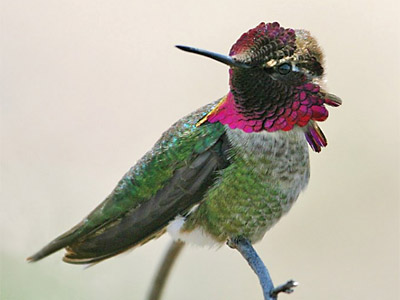 The most interesting part of the trip, though, happened during the ascent. We noticed a tiny hummingbird repeatedly flying in a peculiar pattern: climbing 60 feet, then diving straight down kamikaze style before pulling back up at the last second. When we approached, the hummingbird continued its flight plan unaltered, just barely grazing the top of our heads. It must have repeated this flight plan over 15-20 times in the few minutes we stood watching.
After a brief internet search back home, I learned that we were witnessing a common sight along the coast of California during the early winter months. Anna's hummingbirds (spp. Calypte anna) begin nesting at this time, and males perform these dives as courtship displays to impress their potential female mates.
Interestingly, UC Berkeley researcher CJ Clark recently learned that the randy pilot flares its tail at the bottom of its dive, not only to prevent it crashing to the ground (with a force of 9 g's), but to create a loud chirping sound that attracts females.
Stop motion photography demonstrates the crazy things a little guy will do for a little love. Play on, playa, play on.

Sunday, November 15, 2009
Andrew Zuckerman's Birds

Check out Andrew Zuckerman's photographs of birds.
The bird pictured above is the Vulturine Guineafowl (Acryllium vulturinum). It lives in the Northeast African savannah.
Tuesday, September 15, 2009
Friday, February 6, 2009
Being Caribou
Being Caribou
Diana Wilson, Leanne Allison, 2004, 72 min 19 s
In this feature-length documentary, husband and wife team Karsten Heuer (wildlife biologist) and Leanne Allison (environmentalist) follow a herd of 120,000 caribou on foot across 1500 km of Arctic tundra. In following the herd's migration, the couple hopes to raise awareness of the threats to the caribou's survival. Along the way they brave Arctic weather, icy rivers, hordes of mosquitoes and a very hungry grizzly bear. Dramatic footage and video diaries combine to provide an intimate perspective of an epic expedition.
from the National Film Board of Canada.
Thursday, February 5, 2009


Wednesday, February 4, 2009
Bird Photographs by Eliot Porter
 Barn Swallow, Great Spruce Head Island, Maine, August 21, 1954
 Snowy Egret, Mrazik Pond, Everglades National Park, Florida, January 1974
 Winter Wren, Great Spruce Head Island, Maine, July 18, 1969
 Chipping Sparrow, Great Spruce Head Island, Maine, June 16, 1971
from the Eliot Porter Collection of the Amon Carter Museum.
Tuesday, February 3, 2009
Saturday, January 31, 2009
Backpacking the JMT
A teacher takes 6 of his high school students on a 220-mile backpacking trip across the John Muir Trail.
High Sierra HD - Backpacking the John Muir Trail from Pete Bell on Vimeo.
High Sierra HD - Backpacking the John Muir Trail from Pete Bell on Vimeo.
Subscribe to:
Posts (Atom)