Showing posts with label animals. Show all posts
Showing posts with label animals. Show all posts
Thursday, June 16, 2011


Monday, February 21, 2011
Monday, October 4, 2010


Thursday, August 12, 2010
Trip Report Day 1: Bears at Sequoia National Park
Early Thursday morning, Jess and I drove south to Sequoia National Park. We left Oakland at 7:30 AM, so we could arrive in the early afternoon and secure two of the 25 daily first-come, first-serve Wilderness Permits for the weekend. Although we didn't need to get there quite so early -- we were the first two backpackers to register for the Lakes Loop and Alta Peak trails -- we made the most of our time by setting up our tent at Lodgepole Campground and taking the shuttle to the Giant Forest Museum.
 On the hike back to our campground, we encountered a few bears on the edge of Round Meadow. It was about 4 or 5 in the evening, and the bears were just waking from their afternoon nap. The cubs woke up first, eagerly exploring the edge of the meadow while staying close to the still sleepy big mama bear.
 Luckily, Jess and I just learned about the park's black bears at the Visitor's Center and thus were aware that these fellows were pretty harmless to visitors. They spend most of the day eating insects and berries, and take a nap during the heat of the day. But, my heart was still racing when the mama bear woke up and headed directly toward us. Thankfully, she had no interest in us and started clawing at a fallen Sequoia tree, foraging for insects.
 The rest of the hike was beautiful, but not quite as eventful. The General Sherman tree -- the largest tree in the world by volume -- did not seem to warrant the hype and was a bit anti-climatic.
 We ended the evening by quickly cooking dinner back at our campground and attending a surprisingly informative and interesting presentation about fire by a park ranger.
Friday, April 9, 2010


Wednesday, November 18, 2009
Friday, February 13, 2009
Tuesday, February 10, 2009
A Valentine's Day Treat
 From the Oakland Zoo website:
Ever wonder about the love lives of Animals? Do they really fall in Love? This Valentine’s Day, surprise your sweetie with something unique—an animal encounter you both will never forget! Join us for “Animal Amore” and learn about the courting, mating, and child-rearing habits of some of Oakland Zoo’s most amorous Zoo animals.
This year, we are hosting an “Animal Amore” evening event on two nights, February 13 & 14, 2009. Participants must be 21 years of age or older, because alcohol will be served. Guests will be served appetizers, drinks, dessert and enough information to keep the dinner conversation exciting for years! There will be live animals, prizes, and an erotic tour of the Zoo!
And not to be outdone, the San Francisco Zoo offers its own animal sex tour:
Be you Penguin, Primate or Possum…you are cordially invited to celebrate a San Francisco Zoo original 20th Annual Sex Tour/Woo at the Zoo with Jane Tollini. Come join us for new animals, new positions, new kinky information, ins & out, ups & downs of animal sex, all animals A to Z including U.
Heads & tails above flowers & candles; no better way to impress your Valentine; and if that is not enough…get up-close with an animal encounter! "Woo at the Zoo" also features a romantic brunch including; mimosas, French toast station, scrambled eggs, pastries, chocolate covered strawberries, fresh fruit and a delicious surprise. The special evening events will include; beef tenderloin, herbed couscous, sautéed spinach w/ pine nuts & golden raisins, salad and chocolate dipped strawberries. Reservations are required as this “sense”ational event sells out each year.
I kid you not. I would have gotten tickets, of course, if they weren't already sold out.
Friday, February 6, 2009
Being Caribou
Being Caribou
Diana Wilson, Leanne Allison, 2004, 72 min 19 s
In this feature-length documentary, husband and wife team Karsten Heuer (wildlife biologist) and Leanne Allison (environmentalist) follow a herd of 120,000 caribou on foot across 1500 km of Arctic tundra. In following the herd's migration, the couple hopes to raise awareness of the threats to the caribou's survival. Along the way they brave Arctic weather, icy rivers, hordes of mosquitoes and a very hungry grizzly bear. Dramatic footage and video diaries combine to provide an intimate perspective of an epic expedition.
from the National Film Board of Canada.
Tuesday, December 23, 2008
Monday, November 10, 2008
Monday, August 18, 2008
Tuesday, July 15, 2008
Rattlesnake!
My brother Jeff, his girlfriend Danielle, my friend Joe and I went camping up at Lake George this past weekend. After two days of roughing it and camping in the wilderness, we decided to give ourselves a break and camp in a designated site. As soon as we pitched our tents, I heard my brother scream like a little girl and run towards the car. Usually I ignore my brother's screaming, but Danielle screamed too. So I took a look and here is what I saw:
The funny thing is, no one really freaked out. After the snake went along its way, we continued to pitch our tents with hardly a worry. If this had happened in 'the wilderness' (a site not designated for camping), we all would have insisted on a motel room.
The funny thing is, no one really freaked out. After the snake went along its way, we continued to pitch our tents with hardly a worry. If this had happened in 'the wilderness' (a site not designated for camping), we all would have insisted on a motel room.
Thursday, June 19, 2008
The Largest Rodent in the World
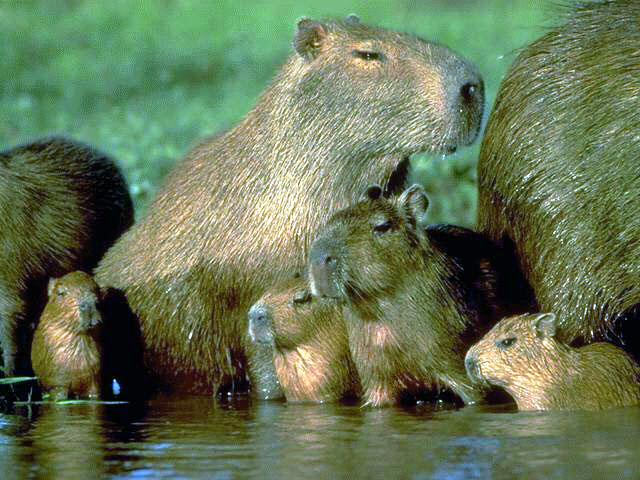
The capybara is the largest rodent in the world. Its extinct ancestors were once the size of grizzly bears! Discover more about capybaras on Wikipedia.
Wednesday, June 18, 2008
Thursday, May 15, 2008
Spanish Dancers
Check out the beautiful movement of this graceful animal, the sea slug (which is classified in the mollusk phylum and more specifically the gastropod class). They are called "Spanish Dancers" for good reason!
Reminds me of the flamenco dance I saw at Riverdance in high school.
Saturday, April 26, 2008
The "Transformer" Owl
What do you do when confronted by an enemy -- ruffle up your feathers and prepare for a showdown, or shrink in size and try to hide? If you're the Southern White-Faced Owl (P. granti), it all depends on the enemy. When confronted with a slightly larger bird, the owl increases its size and aggressiveness to ward off a potential conflict. When confronted with a much larger bird, however, it decreases its size and attempts to hide and avoid confrontation. Check out the YouTube video above -- it's hilarious.
Sunday, December 23, 2007
The Daily Mammal
 The elephant shrew, above, is more closely related to elephants than rodents.
Jennifer Atkins has an ambitious goal: draw every mammal species on Earth. Since there are 5,000 named mammals, she expects the project to take 14 years if she draws one animal every day.
Follow her progress here.
Top 10 Wildlife Conservation Stories for 2007


Read brief summaries about the work being done by conservationists to save nature's endangered species.
Saturday, November 10, 2007
Confirming a Bias
In a previous post, I warned you of the danger of squirrels. New Scientist, a reputable scientific journal, has published legitimate scientific research to back up my claims!
Relying on data collected from infrared (IR) video taken, scientists have concluded that squirrels use heat-emitting bushy tails to ward off predators! And I quote Jeff Hecht:
What's really amazing is that the ground squirrel will heat its tail when confronted by a rattlesnake, which detects IR light, but will not heat its tail when confronted by a gopher snake, which does not detect IR light.
Don't believe me? See for yourself. View the YouTube videos in the New Scientist article.
Relying on data collected from infrared (IR) video taken, scientists have concluded that squirrels use heat-emitting bushy tails to ward off predators! And I quote Jeff Hecht:
It's Californian ground squirrel versus rattlesnake in a potentially lethal showdown. But the squirrel has a secret weapon that until now has remained invisible to the human eye.
The ground squirrel heats up its tail then waves it in the snake's face - a form of harassment that confuses the rattler, which has an infrared sensing organ for detecting small mammals.
What's really amazing is that the ground squirrel will heat its tail when confronted by a rattlesnake, which detects IR light, but will not heat its tail when confronted by a gopher snake, which does not detect IR light.
Don't believe me? See for yourself. View the YouTube videos in the New Scientist article.
Subscribe to:
Posts (Atom)