Friday, January 15, 2010

Channel Islands National Park Trip Report

If you find yourself stuck in busy Los Angeles, the Channel Islands make a great day trip. They are located just miles away from the coast of Southern California and are free to visit, as long as you secure transportation to and from the island.

For $88, I reserved a pair of tickets a week in advance with the park's official boat concessionaire, Island Packers. Just one day before our scheduled departure, though, an employee from Island Packers called to inform us the trip to Anacapa Island was canceled. According to the employee, the cancelation was due to rough waters, but I suspect the real reason was due to low turnout. Fortunately, we were able to transfer our reservations for a day trip to Santa Cruz Island instead.

On Tuesday morning, we set out from the harbor in Ventura, California with about 20 other passengers. After a pleasant hour-long boat ride, we landed at Scorpion Ranch on the eastern tip of Santa Cruz. We ate our packed lunches on the beach, and then set out for a five-mile hike to Potato Harbor. The trail hugged the steep coastal cliffs of the island.

Although the views were great, I was really hoping to spot wildlife found only on these islands, especially the island fox. Even though we found numerous fox scat along the hiking trail, we didn't see any island foxes during our 5-hour stay on Santa Cruz. I learned later that overnight campers have the best chance of spotting these foot-long critters, because they often come out of their burrows at dusk.

I left Santa Cruz a bit disappointed, but we were lucky to experience plenty of marine wildlife on the boat ride back to shore. First, we encountered several migrating gray whales. Every winter, these mammals travel along the Pacific coast to warm and sunny Baja California. Interestingly, they travel in pods of three -- typically, two males and one female -- because the males need assistance to mate with their female partners. As our tour guide put it, "it's hard to have sex without any limbs."

We were also lucky enough to encounter a pod of playful dolphins on the way back as well. The captain slowed the boat down, waiting to arouse the curiosity of the dolphins. Then, he'd gun the boat at full speed -- 20 knots -- and the dolphins would race alongside us.



Saturday, January 9, 2010

NDT: Using a Gravitational Tractor to Prevent a Meteor Strike


"You know the solar system's a shooting gallery. And Earth, many people don't know, plows through several hundred tons of meteors a day. So, the range of these that could hit us is huge.

Apophis – that was discovered in December 2004. It's an asteroid about the size of the Rose Bowl. If the Rose Bowl – imagine that as kind of like an eggcup, and you place something in it to hold it, that's about how big that asteroid is. That's not too shabby – that one, if it hits, it'll do some serious damage.

The first calculation showed that there was a real chance it could hit Earth in the year 2029 on April 13th. Which, by the way, happens to be a Friday.

As the months went by we had better orbital data and we determined that no, it will not hit us April 13th 2029, but it will come very close. It will come closer than Earth's orbiting communication satellites. It'll be the biggest, closest thing we've ever seen in the history of history. It'd be visible from northern Europe and it's basically – think of it as a shot across our bow. The universe saying, "I'll miss you this time, but I'll give you another chance to try to deflect me."

What many people, we have top sort of engineers and dynamicists working on – one problem, which is – involves what we call a gravitational tractor. A kind of a tractor beam where you send up a spaceship, bring it close to the asteroid, but not touch it, and you sort of park it there. And what I mean by – both of these are moving through space so when I say park, I mean you match velocities with the asteroid. And their mutual gravity will want to attract them to each other. And as they drift, you say, no, I'm not going to let that happen. So, you put on the little retro rockets on the rocket to prevent them from colliding. The act of doing that effectively tugs the asteroid out of harm's way. Because all you really want to do is move it so that it will not hit Earth in its trajectory. It'll still be out there, its orbit will still cross the orbit of the Earth, but you've lived to enjoy another day."

Neill DeGrasse Tyson on the radio show, Living on Earth. Listen to the show or read the full transcript here.

Wednesday, January 6, 2010

San Francisco

Bird Action Photos

Click on the images to view in a larger size.


Photographs by Christine Hansen, Rob Palmer, and Nick Dunlop.

Branding is Bullsh*t

Last week, my eyeglasses broke and I reluctantly scotch taped them back together. I had no other choice; my disposable contact lenses ran out months ago and I didn't have a spare pair. With my new (and less than improved) look, I was worried about being seen in public. Those grade school fears crept into the back of my head; I worried that people were going to label me dweeb.

Eventually I manned up, went out, and realized that no one cared. Even if they did, they didn't treat me any differently. Okay, I'll probably need to get a new pair of glasses before I go to a job interview or take my girlfriend to a fancy night out on the town; but in most situations, such a blemish is going to go unnoticed. Pop culture projects an image of perfection that almost all of us find alluring; in all likelihood, we aspire towards perfection ourselves. But, in reality, we (and everyone else) are already flawed in millions of countless ways. And, often, it's going to go unnoticed to just about everyone else if you display just one more flaw to the world.

Granted, I've garnered a bit of immunity from my childhood. Despite years of pleading, I didn't get my first pair of jeans until the 6th grade -- and they were powder blue Lee jeans. When everyone was just getting over the Reebok Pumps and moving onto Nike Airs, my mother bought me a pair of Spaldings from Bradlees. But these devastating setbacks in my childhood actually did teach me a lesson. Sooner or later, people are going to get to know you and judge you for who you are. You best go out, find the good people, and stick with them.

It's a lesson that often bears repeating. In my third year of teaching, I broke my nose and had to wear a giant shiny metal plate that obscured much of my face. I was worried I was going to be harassed by my students, but after just five to ten minutes, my 8th grade students didn't care either. After two weeks, none of them even noticed when I finally removed the plate.

When I went about hunting for a cheap pair of frames this week, I was grateful to learn that Walmart offered eyeglass frames for $9. My current pair had cost more than $200 and lasted less than two years. I wasn't going to invest 20 times more for a pair of designer glasses -- what difference would it make, when people don't even notice anyway?

These differences in price reveal the unconscious power of branding. Smokers pay $2 more for a pack of Marlboro's, kids pay premium prices for Air Jordan sneakers, and the myopic pay $100 for a pair of Nascar or Randy Jackson glasses at Walmart or $300 for a pair of Gucci or Guess glasses at Cohen's Fashion Optical rather than suffer the unbearable cost of wearing discount frames. But are these fears real or just imagined?

Maybe I'd feel a bit differently if my self-image was predicated more on my looks. It's probably true that devastatingly beautiful men and women are treated different by society, and enjoy privileges that the other 99.99% of us lack. But eventually, even the beautiful get old and wrinkled, so it's probably best not to get caught up in one's own physical perfection.

When I was teaching middle school, the biggest diss was to insult a boy's sneakers. My first year teaching, I had a cocksure student named Ruben. He was smart, popular, and at the top of his class both academically and socially. But when he got into an argument with a girl in the school yard, she mocked his sneakers for being dirty. In the moment, he took the criticism in stride, but later I saw him licking his fingers and rubbing his red and white Air Jordans clean like a wounded animal.

We pay a premium to preempt these attacks on our individual psyches. Corporate branding prays on the insecure members of our society. We invest in brand names to associate ourselves with the powerful affluent members of our society and distance ourselves from the powerless poor. But, in the end, we're just spending money to fool ourselves.

Pinnacles National Monument

On Tuesday, December 29, Jess and I drove from Monterey to Pinnacles National Monument. We had spent the last few days hiking and biking along the coast and were looking forward to a change of pace, from taking in endless beautiful ocean views on the central coast to scrambling up talus and chimney rock to spot the elusive and extremely rare California condor in the central valley.

After driving south on Hwy 101 from Salinas, we entered the park via Hwy 146 through its west entrance. Even though Pinnacles' main attraction, Bear Gulch Caves, is located near the the park's other entrance, the west and east entrances are not connected, and driving to the east side of the park would have taken an additional two hours on unpaved one-lane roads. Although I was disappointed to be missing the park's main attraction, the lack of a through-road was in fact a fortuitous sign -- the remoteness of the park means less traffic and more hiking trails and wildlife.

We planned the trip to Pinnacles in order to spot a California condor. We first saw the California Condor (spp. Gymnogyps californianus) a few months ago at the San Diego Zoo and were both impressed. This giant vulture has a wing span of 10 ft. -- they are the largest flying land bird in North America -- and a featherless noggin so it doesn't get too mussed up when it pokes its head in the guts of a dead carcass. It can fly 100 miles per day and live up to 60 years in the wild. Before the arrival of Western settlers, the California condor could be found throughout the US, from as far as California to Florida and Massachussetts. After its numbers dwindled to just 23 in 1981-82, the condor has made a modest comeback -- currently there are over 300 condors, with 90 living in the California wilderness.

Unfortunately, Jess and I weren't lucky enough to spot any condors. In hind sight, we probably had the best chance of seeing a condor in Big Sur, when we saw a researcher holding a giant antenna off a cliff near Hwy 1. Afterwards, we realized she was probably trying to track one of the condors, because they are all radio collared. Nevertheless, we were lucky to enjoy some fun hiking and great views on the Condor Gulch, High Peaks, and Balcony Cliffs trails. The highlight was definitely scrambling over, under, and between wedged rocks in the eery darkness of the Balconies Caves.

West Coast Wish List

After a few months of desperately waiting, I finally landed an interview at a medical school. It's Albert Einstein back in the Bronx. I'm thrilled and excited at the prospect of returning back home and reuniting with my family and friends in New York. But, it also means that my stay in California may be nearly over.

So here's a list of a few goals I'm setting for myself before I leave:
- Visit all of California's National Parks and Mounuments.
- Hang glide in the mountains with the Berkeley Hang Gliding Club. Get my Hang 3 rating.
- Summit three of the 14,000+ ft. peaks in California including either Mt. Shasta or Mt. Whitney.
- Backpack across at least 20 miles of the West Coast, John Muir, or Pacific Coast Trails.
- Spot a California condor and quail in the wild.
- Drive or hitchhike up to Alaska in the summer.
- Complete a sub 3:30 marathon.
- Run my first ultramarathon.
- Join a CSA and learn how to cook without relying on recipes.
- Stop relying on a car if I'm traveling less than 30 miles. Walk, bike, or use public transit instead.
- Go cross-country skiing, snowshoeing, or downhill skiing at Lake Tahoe.
- Hike all of the top-rated trails in Tom Stienstra and Ann Marie Brown's book California Hiking.
- Hike through one of Utah's slot canyons.
- Hop on a freight train.

Admittedly, I'd be thrilled to complete half of these adventures and remain healthy and intact. Hopefully, I'll have some progress to report back in a few months!

Flying off the 600 ft. Hill

Here's a video of my first flight off the 600 ft. hill in over 10 months. I remember being scared (more than usual) for several reasons:
1) My friend Anthony mounted his HD camcorder on my glider for the first time, and I was a bit worried it might affect the glider's performance.
2) I was flying a new approach to the landing zone; making a 90 degree turn from the south instead of the typical west approach.
3) I was launching off the 600 ft. hill unassisted. Anthony had already flown off the 600 ft. hill moments before, and our flight instructor Barry was launching other students off the 300 ft. hill. That meant I had to make my own judgments and decisions on launch -- always a hairy proposition.


It ended being a pretty good flight. I ended up putting my knee on the base tube to bring the Pulse down as fast as I could, but I blew past the spot (the orange cones at the end) anyway. Lots of fun, can't way to do it again and fly off the top of the mountain at 1750 ft!

Hummingbird Diving

On Sunday, Bing, Jess and I went for a 6 mile hike up and down the Montara Mountain / Brooks Creek trail in San Pedro Valley Park. Set in Pacifica, a small coastal town just south of San Francisco, the peak of Mt. Montara offers impressive 360 degree views of the Pacific Ocean to the west, Santa Cruz mountain range to the south, Mt. Diablo to the east, and Mt. Tamalpais to the north. (Unfortunately, I don't have any photographs. Just take my word for it, or hit the trail yourself on a clear day and see for yourself.)

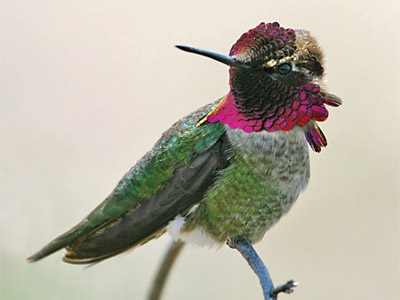
The most interesting part of the trip, though, happened during the ascent. We noticed a tiny hummingbird repeatedly flying in a peculiar pattern: climbing 60 feet, then diving straight down kamikaze style before pulling back up at the last second. When we approached, the hummingbird continued its flight plan unaltered, just barely grazing the top of our heads. It must have repeated this flight plan over 15-20 times in the few minutes we stood watching.

After a brief internet search back home, I learned that we were witnessing a common sight along the coast of California during the early winter months. Anna's hummingbirds (spp. Calypte anna) begin nesting at this time, and males perform these dives as courtship displays to impress their potential female mates.

Interestingly, UC Berkeley researcher CJ Clark recently learned that the randy pilot flares its tail at the bottom of its dive, not only to prevent it crashing to the ground (with a force of 9 g's), but to create a loud chirping sound that attracts females.


Stop motion photography demonstrates the crazy things a little guy will do for a little love. Play on, playa, play on.

Wednesday, November 18, 2009

Sunday, November 15, 2009

Growing Up

When I was young, I was terrified of growing up. I pretty much figured that I would die in a blaze of glory before turning 30, so I could enjoy the best years of my life in full and just forfeit the awful rest.

But now that I'm rapidly approaching the dreaded 3-0, I find myself actually looking forward to my middle-age years.

Don't get me wrong, being a kid is great. We get to live off our parents' dime and discover all the joys and hardships of life.

The temptation is to hold onto this time of discovery, our youth, for as long as possible. But that leads to a path devoid of purpose and meaning, when meaningful 'discovery' becomes aimless 'wandering'.

Growing up is finally willing to circumscribe our existence -- to draw our boundaries and live within them. It is being responsible for our own lives, and maybe others too.

To me, having that weight put on my shoulders is almost like having a burden lifted off of them. I don't have to worry about what I'm going to become, or what I'm going to accomplish in my life. I just have to go out and do it.

Andrew Zuckerman's Birds


Check out Andrew Zuckerman's photographs of birds.

The bird pictured above is the Vulturine Guineafowl (Acryllium vulturinum). It lives in the Northeast African savannah.

Monday, November 9, 2009

Land Skimming on the Pulse

Last Saturday, I transitioned to my first intermediate wing, the Pacific Airwave Pulse 9 meter.

Setting up a Pulse 9m is pretty similar to setting up a Falcon 140. The most important difference is to make sure the foam sitting under the wing's leading edge is not creased before tensioning the glider. The Pulse also has a nose cone, a detachable king post, and a few extra battens that are inserted underneath the wing, but those differences are impossible to overlook when you're setting up.

I launched my glider from the 40' hill. I belly landed my first flight and ran out the second. On my third flight, my instructor Justine noticed that I was pulling in after my launch. So the next time out, I let the glider fly at trim and promptly crashed. My right wing dipped into the hill shortly after take off and I was spun completely around. I cut my arm on the ground but fortunately the wing was undamaged.

Justine took a test flight in my glider and determined that the trim was set too slow. She adjusted my hang strap a quarter inch closer to the nose of the wing, and my next flight was perfect.

Afterwards, we tried to figure out why I couldn't sense the glider was trimmed improperly. Several variables probably affected my judgment: it was a post-frontal day at Ed Levin so the wind conditions were faster and more cross than normal, I was flying a glider I had never flown before, and I was running downhill strong enough to overcome any stalls.

Next time out, I want to take 3-4 more flights on the 40' or 50' hill and then advance up to higher altitudes. Then, I will hopefully be able to evaluate how the Pulse performs compared to the Falcon.

Friday, November 6, 2009

A Personal Reflection On Narrative

On Wednesday, I attended my friend Miriam's poetry reading in Sausalito, a small well-to-do town just north of San Francisco. During her reading, she explained that her work intentionally evokes the "cultural landscape" of her childhood, a small indigent rural farm where everything is old, dilapidated, and mystical.*

Her comment got me thinking. A burden common to all narrative -- in literature, film, and music -- is to successfully conjure up a shared landscape for the author and her audience. While the scale of these landscapes can vary -- they can be as vast as entire worlds or as small as single emotions or thoughts -- they must be clearly delineated within the course of the narrative.

Something to keep in mind if I ever attempt to write a story.

* I enjoyed her poetry very much. This poem is one of my favorites.

A Year of Weddings

Earlier in the year, someone from my high school updated her Facebook status to read: "You know you're getting old when your friends are posting photos of weddings on Facebook instead of photos of drunken frat parties."

So true. Jess and I been invited to six wedding this year, and we've attended four. We're getting old!!

Lebenskunstler

Yesterday, I met up with N. for the first time. Like me, N. quit his job last year, traveled around for a bit, and has been living off his savings.

When I told him my situation, he smiled in knowing delight, "Oh, you're a bum like me!" He continued, "In Germany, we have a saying for people like us. They call us lebenskunstler, which literally means 'life artist' in English."

I like that term -- it certainly has a better ring to it than bum.

Breakup Songs


featured in This American Life episode 339.

The Golden Hills and Nike Women's Marathon

On October 10, I completed the Golden Hills Marathon, a point-to-point trail run through the East Bay Hills. The next weekend, my girlfriend Jessica ran her first 26.2 miler at the the Nike Women's Marathon in San Francisco.

The Golden Hills Marathon is a small event that features just under 110 participants. Although a handful of elite runners participate in the marathon, most of the participants are just average runners like me. It is run in conjunction with the Dick Collins' Firetrail 50, a competitive 50-mile ultramarathon.

The main appeal for the GHM and DCFT is the beautiful setting along the hills of Berkeley, Oakland, and Castro Valley. Much of the course traces the East Bay's Skyline Trail, which offers fantastic views of Mt. Diablo to the west and the San Francisco Bay to the east. My favorite portion of the race came about halfway through the course, along the French Trail in Redwood Regional Park, which immersed us in an old-growth redwood forest just a few miles away from downtown Oakland.

Before the race, I worried about the conditioning needed to complete a trail marathon that included 4800 ft. of climb. I had only run one marathon before, and it was a relatively flat course. My fears, though, ended up being unfounded. Even though I walked up all of the hilly portions of the course, my finishing time was only 1 hour slower than my previous marathon time.

The Nike Women's Marathon is a completely different event. San Francisco swells with runners and spectators from around the country, even though a lottery culls the event to just under 20,000 participants. Still, the race is so large it takes 20 minutes just to get all the runners across the starting line at Union Square.

The course makes it way through some of the most scenic places in the city, including North Beach, Crissy Field, Golden Gate Park, and the Great Highway.

Many spectators pay an extra few bucks to sign up for text messages that help locate their loved ones throughout the course. I wasn't aware of the service, so I picked a spot near the finish line and waited for Jessica the old fashioned way. Even though I was waiting for an hour to spot her, the DJ made the waiting seem more like a party than a spectating event.

Overall, we were both very happy with our respective races. Jess was thrilled to be running in the largest women's marathon in the world, and I was thrilled to participate in a small, well-organized marathon in a beautiful setting.

My Own History of Plagues

by Miriam Bird Greenberg

The year of drought was followed by the year of locusts,
the year of grass fires, the year when daffodils
threaded with cyanide seeds got all the goats.
Then it was the seventeen-year cicadas.
Next the two moons in the sky
looking askance with their white eyes
like a rabbit shucked of its skin in one fluid motion.
The year of my flea-bait boyfriend
with his flock of coonhounds. The year my father
took a long swig from a can of Sterno
and didn't make it back up the basement steps.
The year Jennie got lockjaw turned stiff
and gray as an old board.
Cats got the kitchen mice, but a possum
got the cats and some chickens too,
and Bill shot the possum but didn't count
on the kick, broke his collarbone like a hacksaw gone toothless.
At the end of twelve days ants had got the possum,
and maggots and fifteen kinds of fly,
and we all sat on the porch where the boards hadn't rotted through
drinking gin out of old jam jars as the sun sank
behind grain elevators. Then grandma excused herself,
and Lolly who'd been the hired hand for about a hundred years
left after her, and when I got up for the kitchen
I saw from the corner of my eye
him brushing hair out of her face,
and she had her hand on his waist,
and I knew both would be gone by next year
and the well caved in besides.

Read more of her poems at No Tell Motel.

Monday, September 28, 2009

Old School R&B


Raphael Saadiq on NPR.

Tuesday, September 22, 2009

NDT: "If you're scientifically literate, the world looks very different to you."

Stop Junk Mail

Via the Oakland Recycles website:
In order to cut down on the amount of junk mail you receive, you will need to prevent your name form being traded, rented or sold. This page will help you do just that.

Be patient. It may take three to six months to see the results of your actions. However, your time and effort are well worth a reduction in the amount of unwanted mail you receive.

You can also visit www.stopjunkmail.org for simple instructions.

Tuesday, September 15, 2009

"Will You Return" by The Avett Brothers

Conditional Parenting is Counterproductive

Author Alfie Kohn cites recent research that "conditional parenting" -- i.e., rewarding children with praise for desirable behavior and/or punishing them for undesirable behavior -- is counterproductive. Using a system of punishment and rewards does not promote moral development; instead, it increases negative feelings toward parents/teachers and promotes unhealthy emotions in a child, like anxiety, guilt, and shame.

Instead, parents/teachers should practice unconditional acceptance accompanied by "autonomy support": explaining reasons for requests, maximizing opportunities for the child to participate in making decisions, being encouraging without manipulating, and actively imagining how things look from the child’s point of view.

Kohn states, "Most of us would protest that of course we love our children without any strings attached. But what counts is how things look from the perspective of the children — whether they feel just as loved when they mess up or fall short."

Read the full article at the New York Times.

Mind-Controlling Wasp Parasites


Learn more about zombie animals and the parasites that control them at Discover.

Via Radiolab.

Saturday, September 12, 2009

Friday, September 11, 2009

Monday, September 7, 2009

Southern Soul


Nietzsche Quote

The individual has always had to work hard to avoid being overwhelmed by the tribe. If you try it, you will be lonely often and sometimes frightened. But no price is too high for the privilege of owning yourself.

Thursday, September 3, 2009

Profound Thought No. 5

From the very start Colombe and I have been at war because as far as Colombe is concerned life is a permanent battle where you can only win by destroying the other guy. She cannot feel safe if she hasn't crushed her adversaries and reduced their territory to the meanest share. A world where there's room for other people is a dangerous world, according to her pathetic warmongering criteria. At the same time she still needs them just a bit, for a small but essential chore: someone, after all, has to recognize her power. So not only does she spend her time trying to crush me by every available means, but on top of it she would like me to tell her, while her sword is under my chin, that she is the greatest and that I love her. So there are days when she drives me absolutely crazy. And as for the frosting on the cake, for some obscure reason Colombe, who most of the time is totally insensitive to what's going on with other people, has figured out that what I dread more than anything else in life is noise. I think she discovered this by chance. It would never have crossed her mind spontaneously that somebody might actually need silence. That silence helps you to go inward, that anyone who is interested in something more than just life outside actually needs silence: this, I think, is not something Colombe is capable of understanding, because her inner space is as chaotic and noisy as the street outside...In short, since she can't invade anything else because I am totally inaccessible to her on a human level, she invades my personal auditory space, and ruins my life from morning to night. You really have to have a pretty impoverished concept of territory to stoop this low; I don't give a damn about where I happen to be, provided nothing stops me from going into my mind. But Colombe won't stop at just ignoring the facts; she converts them into philosophy: "My pest of a little sister is an intolerant and depressive little runt who hates other people and would rather live in a cemetery where everyone is dead--whereas I am outgoing, joyful, and full of life." If there is one thing I detest, it's when people transform their powerlessness or alienation into a creed. With Colombe, I've really lucked out.

from The Elegance of the Hedgehog by Muriel Barbery

Tuesday, May 26, 2009

Tom Perrota Quote

[American culture] idealizes youth and equates growing older not with achieving wisdom, but with the gradual loss of all the things we value—freedom, energy, beauty, coolness...

Becoming an adult means choosing—trading in possibility for reality, and accepting the consequences.

Sunday, May 24, 2009

Scavenging

We had a slow night at the Berkeley Free Clinic on Friday night -- a few clients cancelled, so only one male STD screen during the first shift and a routine strep test for the second shift. After the STD screen, the medics let us off the hook early, at around 8:30 pm. My coworker Miriam asked if I wanted to go scavenging with her.

"Definitely," I said.

We headed into the night with our hopes high. We figured we would find a lot of junk on the curb -- some of it possibly useful -- since many UC students had just moved out.

We biked around for a while, eagerly circling South Berkeley for any clothing, furniture, or knick knacks left out on the street.

At first, we were both a little leery of diving into the dumpsters. Then, we ran into a respectable older couple -- a man and woman in their 40s-50s -- eagerly sorting through a huge dumpster. The man, sporting an elegant white beard, was on top of a pile of junk, comfortably sorting through the garbage, just as if he was rummaging in the closet at home looking for his slippers.

That gave us all the confidence we needed. Soon, we were on top of the heap, looking for anything of use.

After a half hour, we had been through three dumpsters. Miriam found a cute crochet sweater, a small juicer, a fancy cookie jar, and a microwave she was possibly coming back for (with a car). I found a polyester Adidas jacket, two brand new MCAT study books, and a handful of highlighters. Everything was in mint condition. Score.

Miriam told me that the mecca of dumpsters in Emeryville. Apparently, an artisanal bakery dumps their day-old bread in a clean, bread-only dumpster. And, a hiking and backpacking store tosses unsold gear in their dumpster. I can't wait to check it out.

Why scavenge? Find out for yourself, or read Anneli Rufus' Scavenger Manifesto.

Raymond Chandler Quote

"There's a peculiar thing about money," he went on. "In large quantities it tends to have a life of its own, even a conscience of its own. The power of money becomes very difficult to control. Man has always been a venal animal. The growth of populations, the huge costs of wars, the incessant pressure of confiscatory taxation--all these things make him more and more venal. The average man is tired and scared, and a tired, scared man can't afford ideals. He has to buy food for his family. In our time we have seen a shocking decline in both public and private morals. You can't expect quality from people whose lives are a subjection to a lack of quality. You can't have quality with mass production. You don't want it because it lasts too long. So you substitute styling, which is a commercial swindle intended to produce artificial obsolescence. Mass production couldn't sell its goods next year unless it made what it sold this year look unfashionable a year from now. We have the whitest kitchens and the most shining bathrooms in the world. But in the lovely white kitchen the average American housewife can't produce a meal fit to eat, and the lovely shining bathroom is mostly a receptacle for deodorants, laxatives, sleeping pills, and the products of that confidence racket called the cosmetic industry. We make the finest packages in the world, Mr. Marlow. The stuff inside is mostly junk."

from The Big Sleep.

Wednesday, May 20, 2009

Fear is Contagious

Scientists at Stony Brook University in New York have the first preliminary evidence that suggest people unconsciously detect fear.

The experiment scanned the brains of volunteers breathing the secretions of people in a state of fear and compared those to the brains of volunteers breathing the secretions of people in a state of calm.

Absorbent pads were used to collect the sweat from 20 first-time skydivers. For comparison, sweat was also collected from the same skydivers when they ran on a treadmill. The sweat was then nebulized,and volunteers unknowingly breathed the secretions while hooked up to a brain scanner.

The brain scans revealed that the volunteers' amygdala and hypothalamus -- brain regions associated with fear -- were more active in people who breathed the "fear" sweat. People, however, were unable to consciously distinguish the two types of sweat.

Dr. Liliane Mujica-Parodi said, "We demonstrate here the first direct evidence for a human alarm pheromone ... our findings indicate that there may be a hidden biological component to human social dynamics, in which emotional stress is, quite literally, 'contagious'."

Scientists believe that many animals -- including all mammals -- have this internal alarm system, since it is favorable to detect fear in others for one's own survival.

Read the full article on the Guardian website.

Monday, May 18, 2009

Aesop Quote

No act of kindness, however small, is ever wasted.

Saturday, May 9, 2009

Monday, May 4, 2009

The Ave Marathon

I ran my first marathon yesterday, along the majestic redwood trees of Humboldt State Park.

It was an ideal location to run my first 26.2 miler -- the 2,000 year-old groves of redwood trees shade the flat course and, I've heard, provide an extra oxygen boost to oxygen-deprived runners as well.

For the first half, I felt great. I paced myself early, staying in a thick pack of casual runners that took time to enjoy the scenery around us.

A quarter into the race, I realized I needed to pick up the pace if I wanted to finish in four hours. I left the comfort of the group and forged ahead.

As the course dragged on, though, my spirits flagged -- by mile 16 my legs were hurting and the few runners around me were bonking. A troubling sign occurred at mile 18, when a dehydrated runner was being loaded into an ambulance, muttering nonsensically.

With five miles left, and my spirits at a low, a deer sprang out of the woods and leapt across the course. Certainly a better omen than yesterday, when Jess and I spotted a pair of turkey vultures near the finish line. I couldn't hold back a loud exclamatory "Wow!" that refocused my effort. I decided to speed up and was amazed when my legs actually responded.

After the last hill, I charged down the last 1000 yards to the finish line, completing the course in 4:01. Not a record-breaker by any calculation, but good enough for me.

Study Tips

* Overlearn - Repetition, repetition, repetition.
* Make it meaningful - Connect what you learn to what you already know.
* Chunk information - Break down info into manageable quantities you can memorize.
* Focus - If you're losing focus, read faster. Speed helps you concentrate.
* Review - Always go back and review what you learned previously.

Monday, April 27, 2009

The Marathon Monks of Mt. Hiei

In 2003, a Buddhist monk named Genshin Fujinami completed the Kaihōgyō, a grueling series of physical and spiritual tests that requires 27,705 miles of walking over seven years:

For 100 consecutive days in each of his first three years as a pilgrim, Fujinami rose at midnight, prayed, ran and walked 18 miles (stopping 250 times to pray), did chores back at the monastery, ate, and hit the sack. In years four and five, he upped his total to 200 consecutive days. Year six saw him complete a 37-mile course every day for 100 consecutive days, then endure the doiri—seven days without food, water, or sleep while sitting upright and chanting 100,000 mantras. In year seven, he trekked 52 miles a day for 100 straight days, usually from 1 a.m. to 5 p.m., then 18 miles a day for 100 consecutive days.

(Source: Outside Magazine)

Fujinami subsisted on a vegetarian diet of vegetables, tofu and miso soup throughout his training.

He is only the 47th person to complete the "marathon meditation" since antiquity. For more info, watch the excerpted Google and YouTube video of the Marathon Monks.
Random Interesting Photos on Flickr

Sunday, April 26, 2009

Suggestions for Becoming a Positive Deviant

1. Ask an unscripted question.
e.g., "Where did you grow up?" or "Did you watch the game last night?"
It's not that making this connection necessarily helps anyone. But you start to remember the people you see, instead of letting them all blur together. If you ask a question, the machine begins to feel less like a machine.

2. Don't complain.
Resist it. It's boring, it doesn't solve anything, and it will get you down. Just be prepared with something else to discuss: an idea you read about, an interesting problem you came across. See if you can keep the conversation going.

3. Count something.
One should be a scientist in this world. In the simplest terms, this means one should count something. If you count something interesting, you will learn something interesting.

4. Write something.
Writing lets you step back and think through a problem. By offering your reflections to an audience, even a small one, you make yourself part of a larger world. The published word is a declaration of membership in that community and also of a willingness to contribute something meaningful to it.

5. Change.
Be willing to recognize the inadequacies in what you do and to seek out solutions.

from Better by Atul Gawande

Jim Jarmusch Quote

“I don’t really believe in originality. Art and human expression are about variations. There’s an ocean of possible ways, but they don’t ever come in the same configuration.”

DFW Commencement Address

I'm supposed to talk about your liberal arts education's meaning, to try to explain why the degree you are about to receive has actual human value instead of just a material payoff. So let's talk about the single most pervasive cliché in the commencement speech genre, which is that a liberal arts education is not so much about filling you up with knowledge as it is about quote teaching you how to think.

Twenty years after my own graduation, I have come gradually to understand that the liberal arts cliché about teaching you how to think is actually shorthand for a much deeper, more serious idea: learning how to think really means learning how to exercise some control over how and what you think. It means being conscious and aware enough to choose what you pay attention to and to choose how you construct meaning from experience. Because if you cannot exercise this kind of choice in adult life, you will be totally hosed.

This, I submit, is the freedom of a real education, of learning how to be well-adjusted. You get to consciously decide what has meaning and what doesn't. You get to decide what to worship.

Because here's something else that's weird but true: in the day-to day trenches of adult life, there is actually no such thing as atheism. There is no such thing as not worshipping. Everybody worships. The only choice we get is what to worship.

On one level, we all know this stuff already. It's been codified as myths, proverbs, clichés, epigrams, parables; the skeleton of every great story. The whole trick is keeping the truth up front in daily consciousness.

Excerpted. Read the full speech here.

Saturday, April 25, 2009

Diligence

"the constant and earnest effort to accomplish what is undertaken."

Wednesday, April 22, 2009

Friday, March 20, 2009

Atthis by Gary Snyder

I.

The painful accumulation of our errors
In dry summer, and her loneliness
And that distracted weeping
Of hot endless afternoons
Foretold the famine

Her swimming fondness
Stretched taut in sterile time
Contracted into dusty fractions
And now the crops are failing.

Since my sorcery has failed
My blood must feed the soil.
Let no delirious priest proclaim
A second coming;
these fragments will stay scattered.


2.

Her life blew through my body and away
I see it whirling now, across the stony places.

I lost her softly through my fingers,
Between my ribs in gentle gusts she
Sifted free, polishing the small bones.

The mute, thin framework takes the winds
That blow across the stony places.


3.
"...Still, she reproached all lands,
calling them ungrateful
and unworthy of the gift of corn"

She shall not be mollified
Til men go mad, and trees have died
For no known reason on the heights
And cornfields withered overnight;
Til Elk have groaned with thirst
And flower buds refuse to burst
Til rivers turn the fish to stone
And rocks are heard again to moan:
Until the sun has been re-tied
To Machu Picchu, men who die
Will be but corpses dressed in frocks
Who cannot speak with birds or rocks.


4. Tiger Song

I gnaw the body of delight
Spit the knotted gristle out
Lap the blood left lie by night

O see your joy digested here
Splintering to the bones of life
That torture with their fractured points
Your concupiscence into strife
Your love into a ball of hair
That cuts me worse than any knife


5.

Poorness and the pride we shared
Our mutual vicious natures bared
Made a jungle of a bed
Gnawed and comforted we fled.
It should have birthed a human child,
Instead our intellects ran wild.

My bitter foe, O sterile lover,
Stranded in my brain, you
Are loved, still loved, there
Which is nowhere,and leaves me
Strangled, bound and dangled, yet
Met, yet of most men most free.


6.

You've gone cold, I suppose
In the prosperous East, with a good job,
Your bright mind turned all brain,
Your wild dancing feet and eyes
Held still, fear
Finally running it all
Under some fancy name.
The summer I hitchhiked from New York
In the hottest week of August
Over the desert and into sea-fog
San Francisco and took you
From your Mother's place, and we hiked
Over Tamalpais, caught a ride
to Tomales Bay, and camped under pines.
You remember it now and put it down,
Turning hard. But I know
How clear and kind your love was
At eighteen, how keen your heart and eye,
How you wrote me of your downtown job,
Sandpipers at Stinson Beach, an old
German you met on a lonely hike
With freckles on his back--the sunburn
On your breasts. even then
I had a terrible thought of time,
And age, and the death
Of our dream-like young love.
It began too soon,
Was too strong too soon,
And it's gone.


7.

Love me love, til trees fall flat
their trunks flail down the berries
Til ripe sharp vines crawl through the door
and the air is full of sparrows

I loved you love, in halls and homes
and through the long library;
I loved you in the pine and snow
now I love blackberry


8.

Half-known stars in the dawn sky
Purple Finch at the feed-tray
A broom beat on a back porch,
tea,
My bent legs, love of you.


9. Up the Dosewallips

In the ruins of a CCC shelter
cooking stew,
rain thru the broken shakes
gorge a low roar,
rain and creeks--

A doe in the meadow
hair plastered to steaming flanks
--hoofprints down gullies
wind whipping rain against cliffs

The trail fades in the meadow,
carins at each rise to the pass.
ash-scars, a ring of stone
--we camped here one other summer--

rainsoaked and shivering
knee deep in squaw grass,

two days travel from roads.


Olympic Mountains


10. Seaman's Ditty

I'm wondering where you are now
Married, or mad, or free:
Wherever you are you're likely glad,
But memory troubles me.

We could've had us children,
We could've had a home--
But you thought not, and I thought not,
And these nine years we roam.

Today I worked in the deep dark tanks,
And climbed out to watch the sea:
Gulls and salty waves pass by,
And mountains of Araby.

I've travelled the lonely oceans
And wandered the lonely towns.
I've learned a lot and lost a lot,
And proved the world was round.

Now if we'd stayed together,
There's much we'd never've known--
But dreary books and weary lands
Weigh on me like a stone.


Indian Ocean

Nice Flare


What a perfect flare. I wish I could do the same!

Tuesday, February 24, 2009

Wednesday, February 18, 2009

Tuesday, February 17, 2009

Barry Schwartz TED Talk: The War on Practical Wisdom

Swarthmore professor Barry Schwartz claims that the rules and procedures of contemporary society retard a person's "practical wisdom" (which, according to Aristotle, is nothing more than a person's moral skill and moral will).

A wise person:
1. knows when and how to make the "exception to every rule."
2. knows when and how to improvise.
3. uses these moral skills in pursuit of the right aims.
4. is made not born.

Schwartz observes that society generally use two tools when things go wrong, rules and incentives. Unfortunately, neither rules nor incentives fix problems on their own; in fact, they tend to make situations far worse in the long run. "Moral skill is chipped away by an over-reliance on rules that deprives us of the opportunity to improvise and to learn from our improvisation. And moral will is deprived by an incessant appeal to incentives that destroy our desire to do the right thing. And without intending it, by appealing to rules and incentives, we are engaging a war on wisdom."

Every person, let alone every head of an organization, should view this talk.

Monday, February 16, 2009

Sunset on Mars


Sunset on Mars casts bluish light over the distant horizon.

from the Nat Geo photo series, Visions of Mars.

Assume the Position with Mr. Wuhl


If links are dead, try Wimp.

Icelandic Jeep


from the TV show Top Gear.

Thursday, February 12, 2009

All We are Doing is Manifesting

Old school parkour and breakdancing:


Wednesday, February 11, 2009

The Destructive Cult of Celebrity

We all have gods, it is just a question of which ones. And in American society, our gods are often celebrities.

In celebrity culture, the object is to get as close to the celebrity as possible. Those who can touch or own a relic of the celebrity hope for a transference of celebrity power.

Real life, our own life, is viewed next to the lives of celebrities as inadequate and inauthentic. Celebrities are portrayed as idealized forms of ourselves. It is we who are never fully actualized in a celebrity culture.

Soldiers and Marines speak of entering combat as if they are entering a movie, although if they try to engage in movie-style heroics they often are killed. The difference between the celebrity-inspired heroics and the reality of war, which takes less than a minute in a firefight to grasp, is jolting. Wounded Marines booed and hissed John Wayne when he visited them in a hospital in World War II. They had uncovered the manipulation and self-delusion of celebrity culture. They understood that mass culture is a form of social control, a way to influence behavior that is self-destructive.

Celebrity culture is a hostile takeover of religion by celebrity culture. Commodities and celebrity culture alone define what it means to belong to American society, how we recognize our place in society and how we determine our spiritual life.

Our choice of brands becomes our pathetic expression of individuality. Advertisers use celebrities to promise us that through the purchase of a product we can attain celebrity power.

Celebrity culture plunges us into a moral void. The highest achievements in a celebrity culture are wealth, sexual conquest and fame. These values are hollow hallucinations that leave us chasing vapors. They urge us toward a life of self-absorption. They tell us that existence is to be centered on the practices and desires of the self rather than the common good.

Celebrity culture encourages us to turn our love inward, to think of ourselves as potential celebrities who possess unique if unacknowledged gifts. It is the culture of narcissism. The banal chatter of anyone, no matter how insipid, has in celebrity culture cosmic significance. Reality, however, exposes something very different. And the juxtaposition of the impossible illusions inspired by celebrity culture and our insignificant individual achievements leads to frustration, anger, insecurity and a fear of invalidation. It leads to an accelerated flight toward the celebrity culture, what Chris Rojek in his book “Celebrity” calls “the cult of distraction that valorizes the superficial, the gaudy, the domination of commodity culture.”

This cult of distraction masks the real disintegration of culture. It conceals the meaninglessness and emptiness of our own lives. It deflects the moral questions arising from mounting social injustice, growing inequalities, and costly imperial wars as well as economic and political corruption.

The fantasy of celebrity culture is not designed simply to entertain. It is designed to keep us from fighting back.

Paraphrased from the column Truthdig column "What Price Hollywood" by Chris Hedges.

Tuesday, February 10, 2009

A Valentine's Day Treat

From the Oakland Zoo website:
Ever wonder about the love lives of Animals? Do they really fall in Love? This Valentine’s Day, surprise your sweetie with something unique—an animal encounter you both will never forget! Join us for “Animal Amore” and learn about the courting, mating, and child-rearing habits of some of Oakland Zoo’s most amorous Zoo animals.

This year, we are hosting an “Animal Amore” evening event on two nights, February 13 & 14, 2009. Participants must be 21 years of age or older, because alcohol will be served. Guests will be served appetizers, drinks, dessert and enough information to keep the dinner conversation exciting for years! There will be live animals, prizes, and an erotic tour of the Zoo!

And not to be outdone, the San Francisco Zoo offers its own animal sex tour:
Be you Penguin, Primate or Possum…you are cordially invited to celebrate a San Francisco Zoo original 20th Annual Sex Tour/Woo at the Zoo with Jane Tollini. Come join us for new animals, new positions, new kinky information, ins & out, ups & downs of animal sex, all animals A to Z including U.

Heads & tails above flowers & candles; no better way to impress your Valentine; and if that is not enough…get up-close with an animal encounter! "Woo at the Zoo" also features a romantic brunch including; mimosas, French toast station, scrambled eggs, pastries, chocolate covered strawberries, fresh fruit and a delicious surprise. The special evening events will include; beef tenderloin, herbed couscous, sautéed spinach w/ pine nuts & golden raisins, salad and chocolate dipped strawberries. Reservations are required as this “sense”ational event sells out each year.

I kid you not. I would have gotten tickets, of course, if they weren't already sold out.

Monday, February 9, 2009

"Pate Filo" by Malajube

The ABC's of Indonesian Fruit

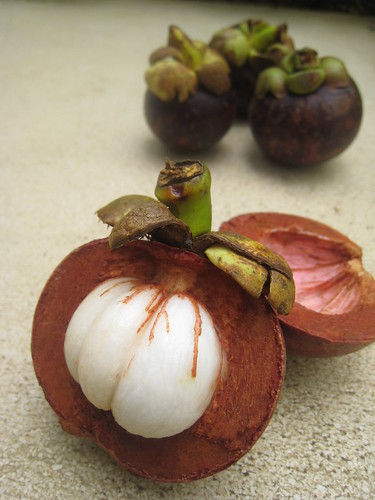
Mangosteen, dubbed by Asians the "Queen of Fruits"


Marquisa Telur Kodok, an Indonesian passion fruit that literally means "frog eggs"


MyKugelhopf writes about delicious Asian fruit. I can't vouch for the "frog eggs," but mangosteen is delicious.

Sunday, February 8, 2009

An Enemy

An enemy is someone whose story you have not heard.

Saturday, February 7, 2009

Live at the NYPL -- Slavoj Zizek and Henri-Bernard Levy

Watch a recent discussion between Slavoj Zizek and Henri-Bernard Levy on iTunes.

Grow an Indoor Lettuce Garden

I've had trouble growing vegetables and herbs in my apartment, but a gardener I talked to recently suggested lettuce. Apparently, lettuce grows well in cool, shady environments -- perfect for the winter.

Read more.

Friday, February 6, 2009

Being Caribou


Being Caribou
Diana Wilson, Leanne Allison, 2004, 72 min 19 s
In this feature-length documentary, husband and wife team Karsten Heuer (wildlife biologist) and Leanne Allison (environmentalist) follow a herd of 120,000 caribou on foot across 1500 km of Arctic tundra. In following the herd's migration, the couple hopes to raise awareness of the threats to the caribou's survival. Along the way they brave Arctic weather, icy rivers, hordes of mosquitoes and a very hungry grizzly bear. Dramatic footage and video diaries combine to provide an intimate perspective of an epic expedition.


from the National Film Board of Canada.

Thursday, February 5, 2009

100 Most Beautiful Words

A fun list by Dr. Goodword.

Words from the list I'd like to use more:
esculent -- worthwhile
gambol -- to skip or leap about joyfully
imbroglio -- an altercation or complicated situation
oeuvre -- a work
panoply -- a complete set
penumbra - a half-shadow, edge of a shadow
peregrination -- wandering, travels
petrichor -- the smell of earth after a rain
redolent -- sweet smelling

Tom Killion Woodcut Prints


Tom Killion's prints are reminiscent of ukiyo-ë landscape masters Hokusai and Hiroshige.

Wednesday, February 4, 2009

Bird Photographs by Eliot Porter

Barn Swallow, Great Spruce Head Island, Maine, August 21, 1954

Snowy Egret, Mrazik Pond, Everglades National Park, Florida, January 1974

Winter Wren, Great Spruce Head Island, Maine, July 18, 1969

Chipping Sparrow, Great Spruce Head Island, Maine, June 16, 1971

from the Eliot Porter Collection of the Amon Carter Museum.

Monday, February 2, 2009

Recess Improves Third Graders' Behavior

According to teachers' ratings, 15 minutes of recess improves the classroom behavior of third graders. (>15 minutes recess showed no measurable improvement.) The study, conducted by the Dept. of Pediatrics at the Albert Eintstein School of Medicine, used public data from 11,000 students. The researchers also found that students with no recess were "much more likely to be black, to be from families with lower incomes and lower levels of education, to live in large cities, to be from the Northeast or South, and to attend public school."

Read the abstract in the journal Pediatrics, or the NYT article .

Sunday, February 1, 2009

Thoughts on Fear

Usually in a moment of actual danger we don't have time to think about being afraid. Imagining dangerous situations creates the real difficulty. We have an experience of fear and then we project it out. We do that because it gives us an opportunity to fight against that situation or run from it. But they're both ways of avoiding the actual experience of fear.

To simply experience a moment of danger can open up into wonder and excitement. It's the avoidance of danger that causes us such difficulties.

paraphrased from an interview of Robert Kull on the NPR program, To the Best of Our Knowledge.

Water

Deepa Mehta's Oscar-nominated film Water tells the tragic story of widowed women in India. According to her faith's Holy Scriptures, a Hindu wife has three options when her husband dies: she can kill herself, marry her husband's younger brother, or live in isolation.

The widows in the story live as social outcasts in an ashram, either by choice or coercion, dependent on alms (and, as the audience learns later, prostitution) for their rent and food.

When one of the shamed widows takes her own life, a deeply religious widow named Shakuntala begins to question the morality of her religion's doctrine. She takes an exploited young widow away from the ashram to see Gandhi speak. The Great Spirit -- a champion of India's oppressed widows and Untouchables -- states "For several years, I believed that God is truth; but now I have realized that Truth is God."

Gandhi's speech erases the moral doubt of the widow (and the audience). The message is clear: we should treat every person humanely, even if it means defying our society's most sacred institutions. In the touching final scene, Shakuntala tries to save her young companion from the hardship of a widow's life, by giving her away.

Paul Virchow Quotes

“Medicine is a social science, and politics is nothing but medicine on a large scale.”

“It is the curse of humanity that it learns to tolerate even the most horrible situations by habituation.”

“Medical education does not exist to provide students with a way of making a living, but to ensure the health of the community.”

“The physicians are the natural attorneys of the poor, and the social problems should largely be solved them.”

excerpted from Mountains Beyond Mountains by Tracy Kidder.

Greenhouse Gas Poisons Oceans, Too

Carbon dioxide, long considered the primary culprit of global warming, is now facing a second serious charge: it's threatening precious marine life as well.

The burning of fossil fuels in our cars, homes, and factories have led to an ever-increasing level of carbon dioxide in the atmosphere. Most of the carbon dioxide stays in the atmosphere and contributes to global warming; one fourth of those emissions, however, are absorbed by the world's oceans.

Carbon dioxide (CO2) is soluble in water -- it dissolves in water to form carbonic acid (H2CO3). Scientists estimate that the acidity of the oceans have increased 30% since the beginning of the Industrial Revolution.

The acidity threatens the survival of coral reefs and shellfish, which in turn, can disrupt the food web of oceans.

Read the original article in the NYT.

Terry Gross Receives 2007 Literarian Award

Sometimes when I love a novel, there is a question I'm tempted to ask, but don't. And the question is something like, 'How did you manage to look into my own heart? How did you find the words to express feelings I didn't even know I had before reading your book?' I guess that's a question a lot of readers might like to ask, but it's also a question no writer can ever really answer.

View Ira Glass' intro and Terry Gross' acceptance speech.

Saturday, January 31, 2009

"A More Perfect Union"


The greatest speech of our generation.
Read the full text at the Huffington Post.

Backpacking the JMT

A teacher takes 6 of his high school students on a 220-mile backpacking trip across the John Muir Trail.


High Sierra HD - Backpacking the John Muir Trail from Pete Bell on Vimeo.

"Begone Dull Care" featuring the Oscar Peterson Trio


"Begone Dull Care" is an abstract film that features the dazzling piano play of Oscar Peterson. Duke Ellington dubbed Peterson the "Maharaja of the Keyboard."

Friday, January 30, 2009

South Africa's Answer to American Hip Hop


This song was featured prominently in the 2005 South African film Tsotsi. According to Wikipedia, the languages heard in the film include Tsotsitaal (an Africaans creole 'thug' language), Zulu, Xhosa, English, and Africaans. Not too surprising, given that South Africa has 11 official languages.

Odie


Right back at you, Odie.

MIA speaks about music as agent for social change

Grammy- and Oscar-nominated artist MIA speaks about the Sri Lankan genocide of Tamils on the Tavis Smiley Show (Click link to view interview).
"The pressure of standing up for nothing is just so big."